Tuesday, January 25, 2022

EPA Approves Enlist One/Enlist Duo Labels (Prostko)

On January 11, 2022, the EPA approved the registrations for Enlist One (2,4-D choline) and Enlist Duo (glyphosate + 2,4-D choline) for an additional 7 years (2029).  However, there will be significant label changes to help further protect the environment, pollinators, and endangered species.  The following are some (not all) of the important label changes for the Enlist One/Enlist Duo herbicide labels:

1) Do not apply this product when soil is saturated or at field capacity, or when a storm event likely to produce runoff from the treated area is forecasted (by NOAA/National Weather Service, or other similar forecasting service) to occur within 48 hours following application. 

2) Do not irrigate treated fields within 48 hours of application.

3) For land with Hydrologic Soil Groups A & B: The land manager/applicator must effectively implement runoff mitigation measures in the following table to equal a minimum of 4 credits. For land with Hydrologic Soil Groups C & D: The land manager/applicator must effectively implement runoff mitigation measures in the following tables to equal a minimum of 6 credits. 


4) For soybeans (POST): Apply when weeds are no larger than 6 inches and any time after soybean emergence through the R1 growth stage.  Do not apply after the R1 growth stage. 

5) For cotton (POST): Apply when weeds are no larger than 6 inches and any time after cotton emergence up to first white bloom. Do not apply after first white bloom.

6) Restrictions prohibiting their use in certain counties in certain states due to endangered species. 

Enlist One is not prohibited in any GA counties.  

Enlist Duo use is prohibited in 11 counties in GA (Baker, Berrien, Brooks, Burke, Calhoun, Early, Irwin, Lee, Miller, Screven, and Worth).

7) A complete copy of these new herbicide labels can be obtained at the following locations:

Enlist One: https://s3-us-west-1.amazonaws.com/agrian-cg-fs1-production/pdfs/Enlist_One_180122.pdf

Enlist Duo: https://s3-us-west-1.amazonaws.com/agrian-cg-fs1-production/pdfs/Enlist_Duo_Label1h.pdf

Friday, January 14, 2022

Alternatives for Roundup for Weed Control in Field Corn (Prostko)

I continue to hear much chatter about the shortages/price increases for Roundup (glyphosate) and many other herbicides.  Thus, I would like to remind you of some of the options available to field corn growers who are trying to be more judicious with their use of glyphosate and/or get away from it completely.  Please consider the following:

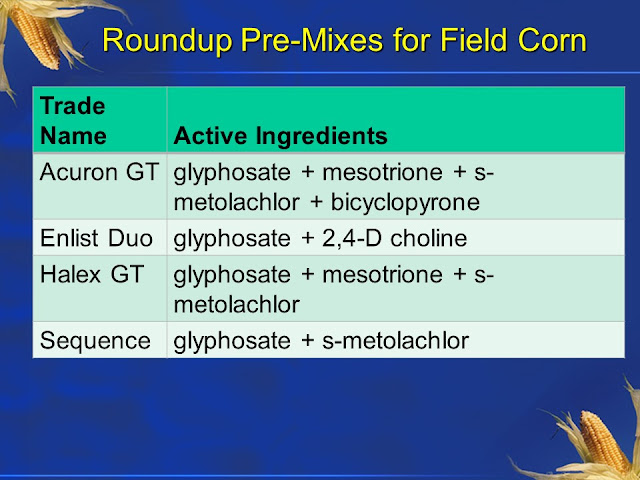
1) Growers who are having trouble finding glyphosate and/or don't like the price, might have a better chance of getting it in a pre-mix formulation.  The following are various glyphosate pre-mixtures for use on field corn:

**Note: Enlist Duo can be applied preplant to any field corn hybrid but can only be applied postemergence on Enlist field corn hybrids.

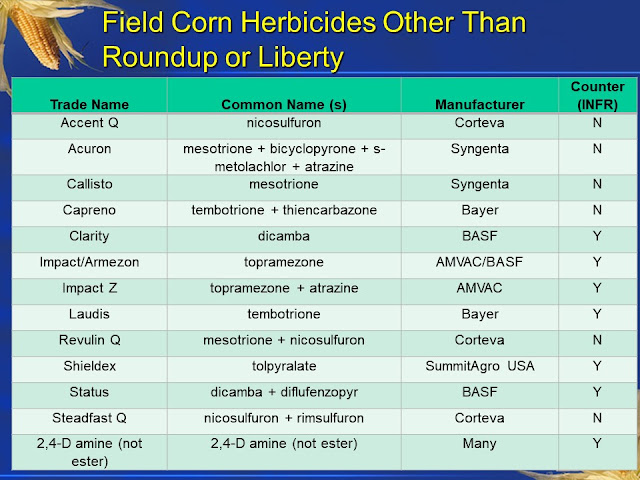
 2)  Roundup-Ready field corn was first commercialized in 1998.  Prior to that time, field corn growers were managing weeds in-crop without glyphosate.  It might not have always been easy or perfect but it was good enough to make top yields.  Since that time, there have been other herbicides developed for use in field corn.  The following table lists various field corn herbicides that have been tested by UGA and will provide very acceptable weed control when applied at the V3-V5 stage of growth (still need to be tank-mixed with atrazine): 

3) If a grower chooses to not use glyphosate, I would anticipate slightly less overall grass weed control.  Thus, field corn growers should consider the use of the following herbicides for residual grass control in field corn: Anthem Maxx; Dual Magnum; Outlook; Prowl (POST only); Warrant; and Zidua.

4) More specific information about the use of these herbicides can be found in the 2022 Georgia Pest Control Handbook - Special Bulletin 28 available on-line at the following address:

https://extension.uga.edu/content/dam/extension/programs-and-services/integrated-pest-management/documents/handbooks/2022-comm-chapters/Corn.pdf