Thursday, March 31, 2022

Empyros™ Herbicides for Field Corn? (Prostko)

I received a few questions about "new" corn herbicides being sold by Helena® under the trade name of Empyros™.  Here is some information for you in case you get asked questions:

1) There are three different products being sold under that brand name.  I was under the impression that only the Empyros™ formulation would be sold in the south but I could be wrong on that one.


2) Last year was the first time that I had the opportunity to evaluate these specific pre-mixes.  Generally, they performed very well but I only have 1 year of data.  I just planted another test on Monday (03/28/22) to get another look. Check out these field pictures from 2021:


3) For more information, check out the product labels:


4) The active ingredient, tolpyralate, is also sold under the trade name of Shieldex® 400SC from SummitAgroUSA.  After collecting multiple years of data, Shieldex® was added to the "official" field corn weed control recommendations in the 2022 UGA Pest Control Handbook Vol. 1 (page 69).  Check out this field picture from 2021:


5) A copy of the Shieldex® label:


6) Tolpyralate is a WSSA Group 27 herbicide (HPPD inhibitor) thus is very similar to other actives in this group such as tembotrione (Laudis®), mesotrione (Callisto®), and topramezone (Impact®).

Tuesday, March 29, 2022

Pigweed At Burndown? (Prostko)

I received this picture from a grower yesterday who was about to burndown with some Roundup (before looking in the field).  This field was treated with a Roundup + 2,4-D combo several weeks ago (but no residual).  Two main takeaways here:  1) always a great idea to include a residual herbicide in a preplant burndown weed control program especially when applied many weeks before planting; and 2) the very best thing a grower can put in a field is a foot.  In this scenario, Roundup would not have been a great option because of resistance.  The grower wisely switched to Gramoxone (and was also including Dual Magnum) since he will be planting field corn and soybean. 


Friday, March 18, 2022

Preplant Burndown Update (Prostko)

Some responses to a few common questions this week about preplant burndowns:

1)  What is the plant-back restriction for field corn following an application of 2,4-D?

Plant-back restrictions for field corn after a burndown application of 2,4-D are 7 days (16 oz/A) or 10-14 days (>16 oz/A)

2) If a grower cannot wait to plant field corn in 7-14 days after an application of 2,4-D, what other burndown options are available? 

Roundup (glyphosate) or Gramoxone** (paraquat) + Atrazine 4L (32 oz/A) is my first choice.  There are no field corn plant-back restriction for these treatments.  Check out the following picture from my burndown plots yesterday in a Tift Co. growers' field (many thanks to Justin H. and Regan V.).


3) What's the best option for controlling a failed stand of field corn?

It has been my experience that the best option for controlling a failed stand of field corn is to use Select Max 0.97EC (or other equivalent formulations) @ 6 oz/A + NIS. But, there is a for real 6 day plant-back restriction (field corn) for this treatment.  Since many of our current field corn hybrids have tolerance to both Roundup and Liberty, neither of these are great options.  Gramoxone has been too inconsistent for me to have much confidence.  FYI, it takes about 10-14 days before you really start to observe the full effects of Select Max.  


4) What is our current recommended preplant burndown program for peanut?

Roundup or Gramoxone** + Valor @ 2 oz/A + 2,4-D (1 pt/A).  An additional 2 oz/A of Valor can be applied at planting.  Peanuts can be planted anytime.


**When using Gramoxone on small grain cover crops, applications need to be made when seedheads are present.

Wednesday, March 9, 2022

Counter (terbufos) and Herbicide Reminders (Prostko)

Since we have so many new folks on our UGA Extension team, here is a quick follow-up to Dr. Bob K's earlier e-mail about the use (or not) of Counter with certain herbicides in field corn:

1) Why is it a bad idea to apply certain herbicides, particularly ALS herbicides and some HPPD herbicides, following an in-furrow (INFR) application of Counter in field corn?

Both the insecticide and the herbicide are metabolized (i.e. broken down into non-lethal compounds) by the mixed function oxidase enzyme (MFO) system.  Simply put then, the use of both products overloads the field corn plant's ability to metabolize the chemicals.  

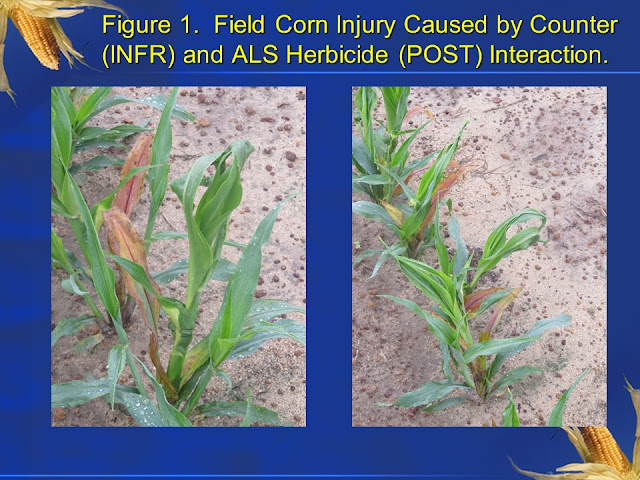
2) What does corn injury from this negative interaction look like?


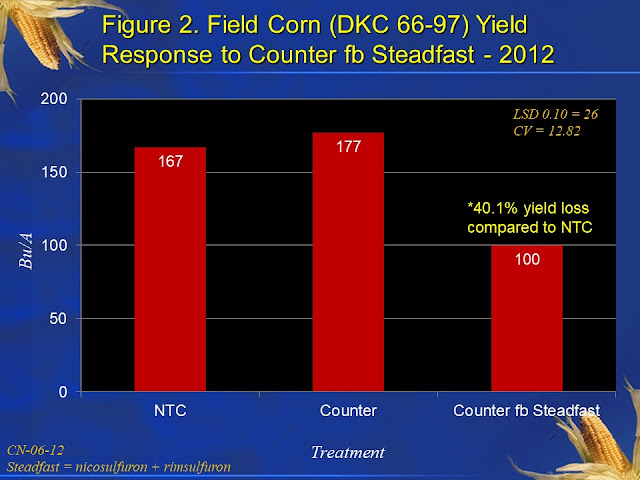
3) How much can corn yields be reduced?


4) Where can I get more info about herbicides that can or cannot be used following an INFR application of Counter?

a) Check out the the following information from AMVAC:

https://www.amvac.com/sites/default/files/_media/product/document/2022_Counter_Tech_Sheet.pdf

b) You should also be able find this information in 2022 Georgia Pest Control Handbook:

https://extension.uga.edu/content/dam/extension/programs-and-services/integrated-pest-management/documents/handbooks/2022-comm-chapters/Corn.pdf


Wednesday, March 2, 2022

Grass Herbicides for Pre-Plant Burndown?? (Culpepper and Prostko)

Thinking about using a grass herbicide such as Select Max (clethodim) for pre-plant burndown? Have you seen any data suggesting this is a wise decision?

Interestingly, there is a lot of buzz about using grass herbicides to burndown small grain cover crops and annual ryegrass because of the glyphosate price/shortage issues.  Most of the conversations also include tank-mixing the grass herbicide with either 2,4-D or dicamba and applying as a March/April burndown.

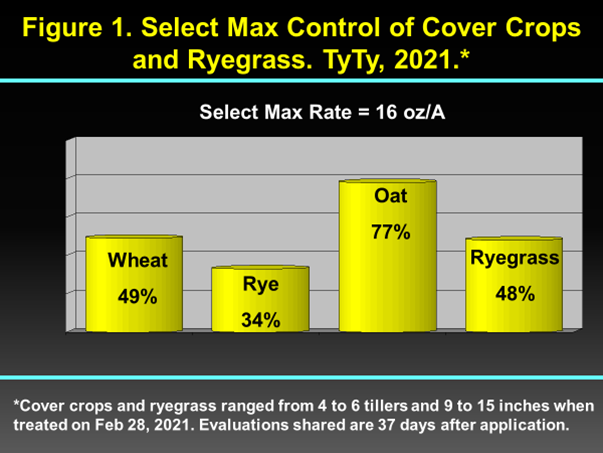
Prior to making the effort and spending a significant amount of money, it might be wise to review the grass herbicide label itself for the level of control the product potentially offers.  Additionally, you may find value in the data we generated in 2021 (Figure 1). A couple of important clarification notes regarding this research are as follows: 1) the application was made on February 28 (2021) when conditions were cooler; 2) we did not tank-mix with dicamba or 2,4-D, which could negatively influence grass control (i.e. antagonism); and 3) this is data from only one location.

When considering your burndown treatment for 2022, a significant amount of research suggests that the value of glyphosate may be at its maximum for the pre-plant burndown application if grasses are present in the field. Thus, we would encourage staying with the burndown program that you know is successful if anyway feasible. Planting into weed-free fields, with the potential lack of some postemergence herbicides this year, will be extremely important.

Once grassy weeds, as well as other broadleaf weeds are mature, Gramoxone (paraquat) + diuron + COC (cotton) or Gramoxone + Valor + 2,4-D amine + COC (peanut) are fantastic options (small grains must have seed heads). It appears, at least currently, that most of our winter weeds are maturing at a faster rate than in the past so these treatments may be very timely options.

Tillage is also a very effective option as you well know, just be cognizant implementing steps to avoid soil erosion.

Another possible negative.  If Select Max is used prior to planting field corn, the plant-back restriction would be 30 days.  The rate needed for burndown control (marginal) is much higher than the rate needed for volunteer corn control thus warrants a longer restriction.