Friday, March 31, 2023

Pre-Plant Burndown Update - Prostko

I am still getting quite a few inquiries about pre-plant burndowns.  Thus, I thought you might be interested in seeing some of the early results of a current pre-plant burndown test located in Tift County.  Special thanks to County Extension Agents Justin Hand/Regan Veal and Wes Shannon (grower) for their cooperation!  A few comments:

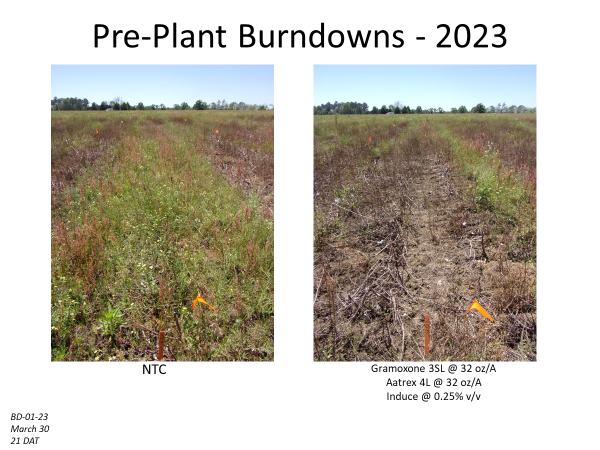
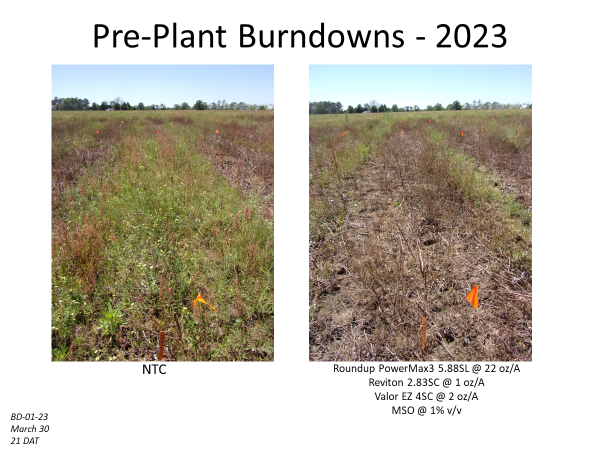
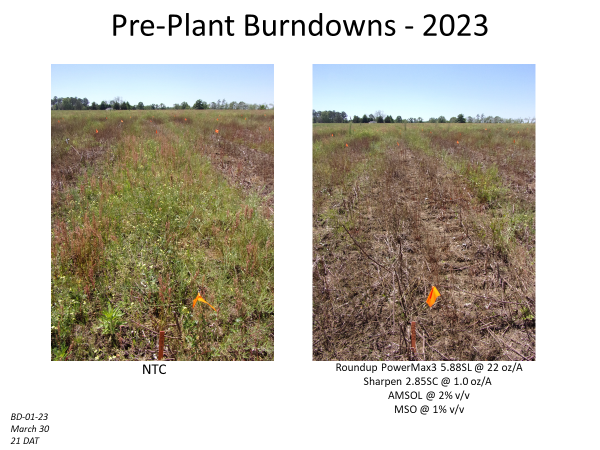
1) All treatments were applied at 7 am on March 9, 2023 (15 GPA with AIXR11002 spray tips).  Main weeds evaluated were wild radish (18-24" tall, flowering) and red sorrel (20-32" tall, flowering).

2) In the first 14 days after treatment (DAT), low temperatures dropped below 45 F for 7 nights.

3) Observations and pictures obtained on March 30 (21 DAT) are as follows:

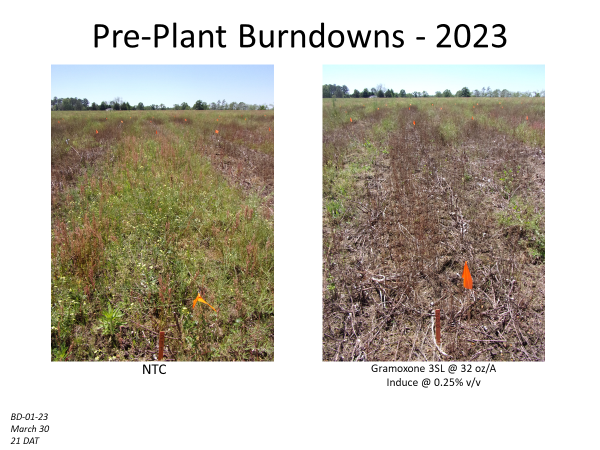
a)  Gramoxone 3SL (paraquat) @ 32 oz/A + Induce (0.25% v/v) was very effective.  No other treatment was more effective in this test.  

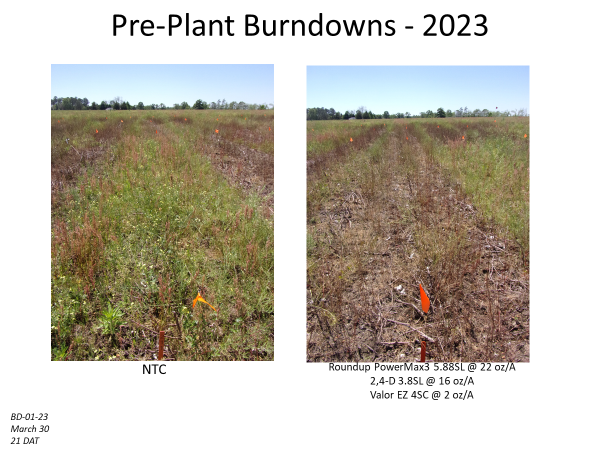
b) Any treatments with Roundup PowerMax3 (glyphosate) + either atrazine, 2,4-D or dicamba were not as effective as anticipated based upon my prior experiences.  I suspect that the cold weather after application influenced the effectiveness of these treatments.  Had I known it was going to be so cold, I probably would have bumped up the rate of Roundup slightly and/or used additional adjuvants (i.e. ammonium sulfate and/or crop oil). Maybe these treatments will look better in another week???
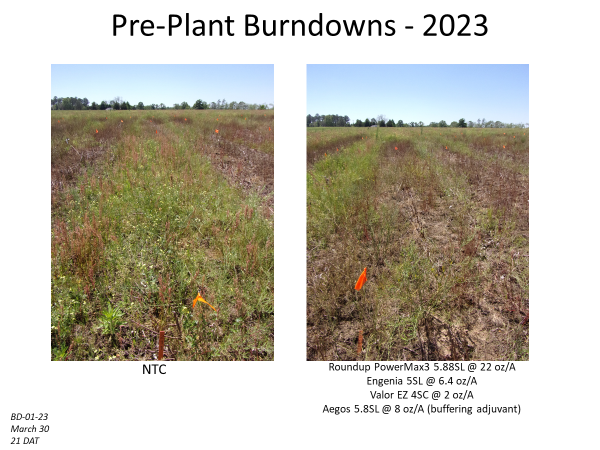


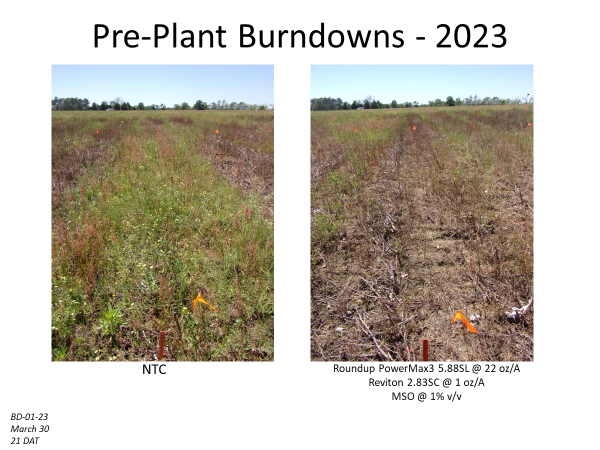
c) Roundup + Reviton 2.83SC (tiafenacil) treatments were also very effective.  Reviton label rotation restrictions are as follows: field corn = 0 days; soybean = 7 days; cotton = 7 days (1 oz/A) or 14 days (2 oz/A).  Reviton peanut rotations restrictions are currently in the process of being reduced to 0 days (1 oz/A) and 7 days (2 oz/A).  Estimated cost of Reviton is around $5-6/oz.


d) The surprise treatment of this test was the combination of Roundup + Sharpen (saflufenacil).  I have not talked that much about Sharpen in the past because its main claim to fame has been horseweed.  Horseweed is usually not the major burndown weed in many south Georgia fields (wild radish and cutleaf evening primrose hold that title).  Perhaps I need to re-evaluate my position on this one??? Current label rotations for Sharpen are as follows: field corn/sorghum = 0 days; soybeans = 30 days; cotton = 42 days + 1" rainfall/irrigation; and peanuts = 120 days. 


4) I am not making any "official" recommendations here.  These comments are based upon observations from this test yesterday (21 DAT).  It takes multiple years of data and observations to formulate "official" control recommendations that eventually get added to the UGA Pest Control Handbook.    


Tuesday, March 21, 2023

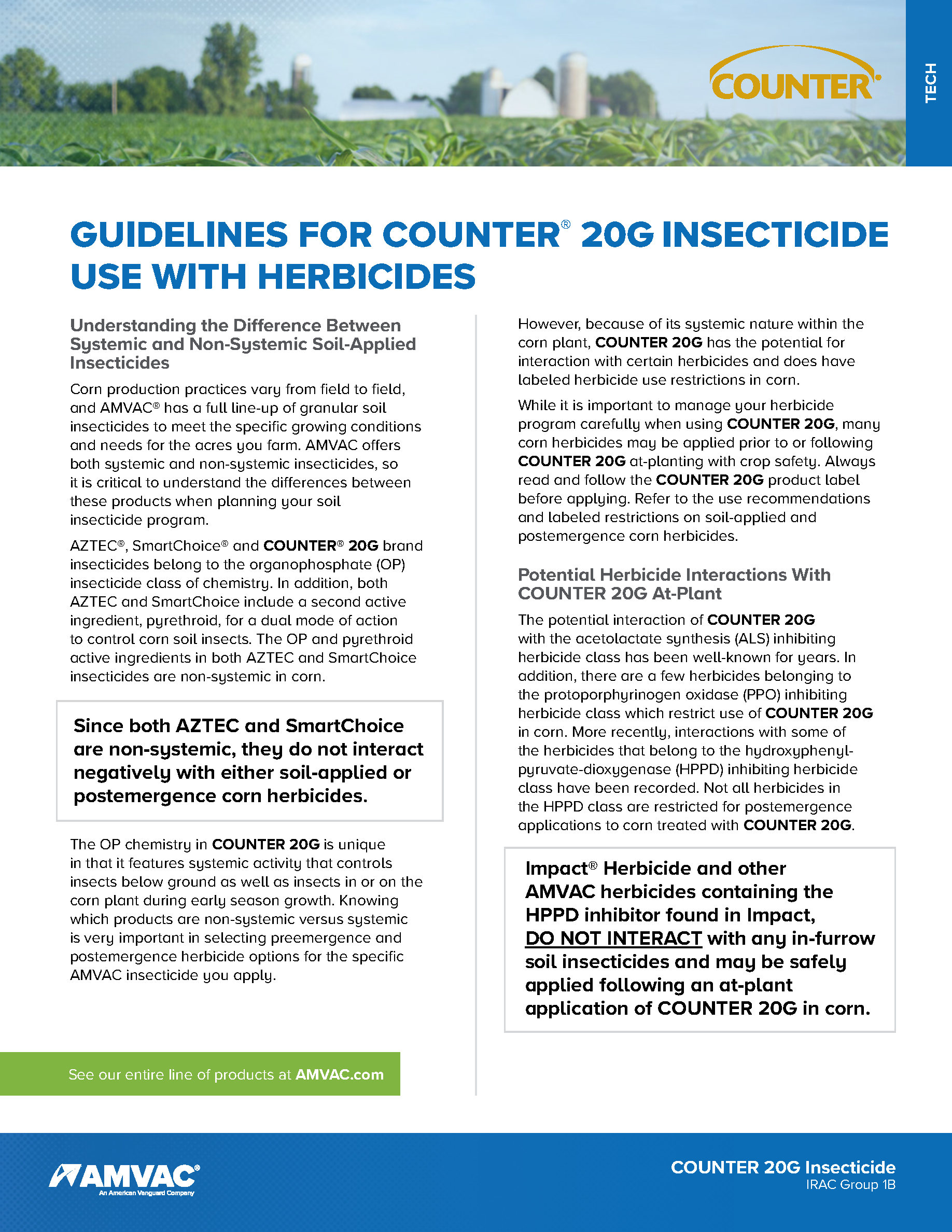
Updated Counter/Herbicide Interactions in Field Corn (Prostko)

In a previous blog (March 9, 2022), I discussed the negative interaction that can occur when Counter (terbufos) or other OP insecticides are used in-furrow and followed by applications of certain herbicides in field corn.  Here is the newest information about the use of Counter and herbicides in field corn from AMVAC® (click on pictures for better clarity).


Monday, March 13, 2023

Cold Weather and Burndowns (Prostko)

Many growers are now in the process of spraying pre-plant burndown herbicides.  Low temperatures over most of Georgia are expected to drop below 40 F over the next three days.  These temperatures are not very favorable for optimum weed control with herbicides such as Roundup (glyphosate) or Gramoxone (paraquat).  Thus, you might want to advise your growers to hold off for a few days until temperatures warm up again (above 40 F but I would prefer warmer).  Here is some data to chew on:

1) From some older air temperature research (47 F, 56 F, 65 F, 75 F, and 87 F) conducted by my colleague at Michigan State University, Dr. Christy Sprague:

a) Air temperatures had very little effect on the control of common chickweed with Roundup.  However, common chickweed control at lower temperatures was compromised with Gramoxone (only 70% control at 47 F).

b) Air temperature had a significant effect on the control of henbit with both Roundup and Gramoxone.  When applied at 47 F, henbit control was < 30% with both herbicides.

2) From Harre et al. (2021) in Weed Technology 35:279-288:

a) Shoot biomass reduction of horseweed and purple deadnettle was 34% and 28% greater, respectively, when paraquat was applied at day/night temperatures of 81/61 F than when applied at 64/55 F.