Tuesday, January 25, 2022

EPA Approves Enlist One/Enlist Duo Labels (Prostko)

On January 11, 2022, the EPA approved the registrations for Enlist One (2,4-D choline) and Enlist Duo (glyphosate + 2,4-D choline) for an additional 7 years (2029).  However, there will be significant label changes to help further protect the environment, pollinators, and endangered species.  The following are some (not all) of the important label changes for the Enlist One/Enlist Duo herbicide labels:

1) Do not apply this product when soil is saturated or at field capacity, or when a storm event likely to produce runoff from the treated area is forecasted (by NOAA/National Weather Service, or other similar forecasting service) to occur within 48 hours following application. 

2) Do not irrigate treated fields within 48 hours of application.

3) For land with Hydrologic Soil Groups A & B: The land manager/applicator must effectively implement runoff mitigation measures in the following table to equal a minimum of 4 credits. For land with Hydrologic Soil Groups C & D: The land manager/applicator must effectively implement runoff mitigation measures in the following tables to equal a minimum of 6 credits. 


4) For soybeans (POST): Apply when weeds are no larger than 6 inches and any time after soybean emergence through the R1 growth stage.  Do not apply after the R1 growth stage. 

5) For cotton (POST): Apply when weeds are no larger than 6 inches and any time after cotton emergence up to first white bloom. Do not apply after first white bloom.

6) Restrictions prohibiting their use in certain counties in certain states due to endangered species. 

Enlist One is not prohibited in any GA counties.  

Enlist Duo use is prohibited in 11 counties in GA (Baker, Berrien, Brooks, Burke, Calhoun, Early, Irwin, Lee, Miller, Screven, and Worth).

7) A complete copy of these new herbicide labels can be obtained at the following locations:

Enlist One: https://s3-us-west-1.amazonaws.com/agrian-cg-fs1-production/pdfs/Enlist_One_180122.pdf

Enlist Duo: https://s3-us-west-1.amazonaws.com/agrian-cg-fs1-production/pdfs/Enlist_Duo_Label1h.pdf

Friday, January 14, 2022

Alternatives for Roundup for Weed Control in Field Corn (Prostko)

I continue to hear much chatter about the shortages/price increases for Roundup (glyphosate) and many other herbicides.  Thus, I would like to remind you of some of the options available to field corn growers who are trying to be more judicious with their use of glyphosate and/or get away from it completely.  Please consider the following:

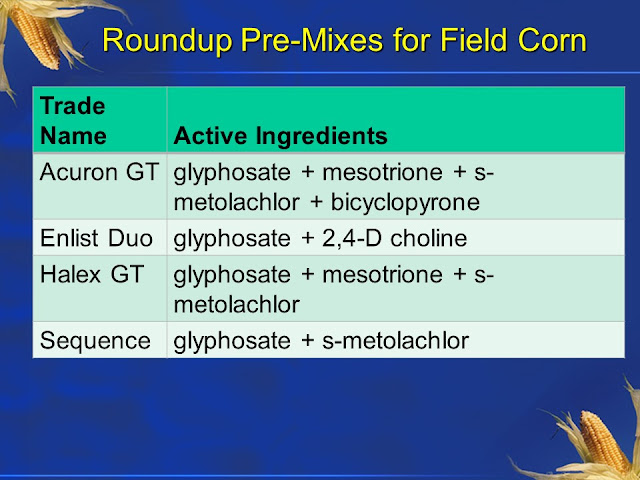
1) Growers who are having trouble finding glyphosate and/or don't like the price, might have a better chance of getting it in a pre-mix formulation.  The following are various glyphosate pre-mixtures for use on field corn:

**Note: Enlist Duo can be applied preplant to any field corn hybrid but can only be applied postemergence on Enlist field corn hybrids.

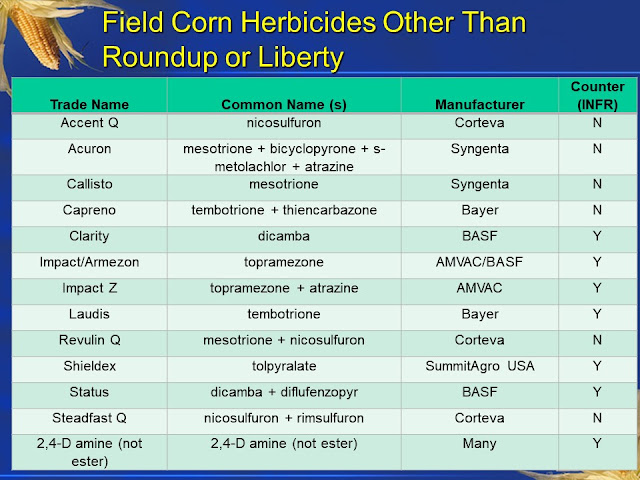
 2)  Roundup-Ready field corn was first commercialized in 1998.  Prior to that time, field corn growers were managing weeds in-crop without glyphosate.  It might not have always been easy or perfect but it was good enough to make top yields.  Since that time, there have been other herbicides developed for use in field corn.  The following table lists various field corn herbicides that have been tested by UGA and will provide very acceptable weed control when applied at the V3-V5 stage of growth (still need to be tank-mixed with atrazine): 

3) If a grower chooses to not use glyphosate, I would anticipate slightly less overall grass weed control.  Thus, field corn growers should consider the use of the following herbicides for residual grass control in field corn: Anthem Maxx; Dual Magnum; Outlook; Prowl (POST only); Warrant; and Zidua.

4) More specific information about the use of these herbicides can be found in the 2022 Georgia Pest Control Handbook - Special Bulletin 28 available on-line at the following address:

https://extension.uga.edu/content/dam/extension/programs-and-services/integrated-pest-management/documents/handbooks/2022-comm-chapters/Corn.pdf


Monday, November 15, 2021

Programs for Controlling Ryegrass and Radish Circular for 2021-2022! (Culpepper and Vance)

Agents, our wheat weed control circular is finalized. For the most part, it remains similar to last year with a few minor adjustments including:

1. Added liquid Zidua formulation (both liquid and dry formulation are labeled)

2. Added comment regarding Fierce and the expectation of the liquid formulation obtaining a label during 2022 (dry formulation labeled now).  

3. Removed Axial from circular; Axial Bold has replaced Axial.

4. Hopefully made tables even more simple to understand. 

If you would like a copy, email Jenna Vance at jcsmith3@uga.edu and ask for one of the following options:

Option 1: Request laminated circulars to be mailed to you. Provide the number of circulars that you would like and provide and address to send them.

Option 2: Request laminated circulars to be brought to you at our Dec. 1 weed training.

Option 3: Request a pdf version. An email response will provide the PDF as an attachment. 

Plans are to bring laminated vegetable circulars to you at our Dec. 1 weed training. In regards to the cotton circular, we are waiting on decisions from the U.S. EPA regarding auxin herbicide labeling requirements/restrictions for 2022 before making edits.


Monday, November 8, 2021

Soybean Green Stem (Prostko)

Last week, I received a few phone calls about soybean green stem (SGS) (Figure 1).  The causes of SGS are not well understood but are likely attributed to various stresses that can effect soybean pod development.  Stresses include problems such as stinkbugs, aphids, thrips, disease, viruses, and environmental.   The use of foliar fungicides, especially the strobilurins, have also been associated with SGS.  Cultivar may also be important as well.  

Herbicides such as paraquat, although very useful for soybean leaf defoliation, have been inconsistent in their effect on SGS.  At this time of year (i.e. harvest), the only management tactics for SGS are making sure combine teeth are sharp, reducing combine speeds, and possibly delaying harvest until when/if/maybe a hard freeze occurs.

For more information, check out this recent (September 2021) publication about Green Stem Syndrome in Soybean from Oklahoma State University. https://extension.okstate.edu/fact-sheets/print-publications/pss/green-stem-syndrome-in-soybean-pss-3003.pdf

Figure 1.  Soybean green stem.


Wednesday, October 13, 2021

Post-Harvest Weed Control (Prostko)

As you have heard many times before, Culpepper and I have been encouraging growers to consider the use of post-harvest (field corn) tactics (tillage, mowing, herbicides) to help manage the soil seedbank for weeds such as Palmer amaranth and tropical spiderwort.  The pictures below are from one of my corn fields that I recently treated with a combo of Gramoxone (paraquat) + Tricor (metribuzin) + NIS.  The green, untreated strips are there by design (checks).  This is one of my preferred post-harvest herbicide treatments especially for Palmer amaranth.  In many fields though, it might be too late if weeds have already produced seeds and/or if younger plants are likely to get terminated (before producing seed) with the first frost (about a month away in many locations). 

FYI, current Tricor label would allow field corn or soybean planting next spring but cotton and peanut rotations are 18 months.  We are trying to get the label changed to allow for a shorter rotation interval for these important Georgia row crops.  


Tuesday, August 10, 2021

Custer's Last Stand or Using Wipers or Mowers For Late-Season Weed Control in Peanut Fields (Prostko)

At some point, peanut growers must realize that it is futile to continue spraying herbicides over the top of their crop.  Either the weeds are too big and/or pre-harvest intervals cannot be followed.  In that case, there are 2 last resort weed control options for troublesome fields.  These include the use of either a non-selective applicator (i.e. wiper/wick bar) or a flail mower.  Flail mowers (vertical blades) are preferred over rotary mowers (horizontal blades) because they uniformly distribute debris rather than dump it on one side of the mower (which can cause major digging problems).  The main goal with these weed control methods is to increase fungicide deposition and/or improve harvestability.  At this time of year, it is really way too late to recover any weed competition related yield losses.  Here are a few things to consider for both options.

1) A 33% or 50% solution of paraquat (depending upon formulation) is legal to apply in a non-selective applicator for the control of Palmer amaranth.  Check out page 223 in the 2021 UGA Pest Control Handbook for more specifics (tractor speed and weed heights are very important).  This treatment will also work well on Florida beggarweed and sicklepod.  No other herbicides are labeled for this type of application so don't bother asking me about Liberty or dicamba (FYI, they don't work well in these applicators either!!!).  I have tested several types of applicators over the years and prefer any of the ones pictured below. You can also check out the following slide set for more information about the research I have conducted on non-selective applicators (http://www.gaweed.com/slides/prostko-swss-2011/index.html).


2) I have used a flail mower to clean up my weedy test plots for many years.  I usually set the mower to remove about 2"-3" of the peanut crop in addition to topping any weeds that are there.  Generally, 1 pass with the flail mower is OK but 2 passes are better (opposite directions). Check out these pictures from earlier today.


Tuesday, July 20, 2021

Rain Delays and Weed Control (Prostko)

Recent rains over the last few days at the UGA Ponder Farm (1.75"+) have kept me out of the field for today so I thought it would be a good time to squeeze in a quick blog. The frequent rain showers we have had over the last month or so have caused many problems with growers who have not been able to get in the field to make pesticide applications.  Since its now July 20 and getting late for just about everything, here are a few things to think about in regards to weed control in various crops:

1) The application cut-off date for all dicamba applications in tolerant soybean was June 30 and is July 30 for tolerant cotton. 

2) If at all possible, growers need to avoid making applications of Cobra or Ultra Blazer to peanuts during the 60-80 DAP time frame.  There have been yield losses (5-10%) associated with the application of these herbicides during this period (usually R5-R6 or beginning to full seed stage).  Cobra can legally be applied up until ~100-105 DAP since it has a 45 day PHI.  The PHI for Ultra Blazer is 75 days.


3) Yes, it is my opinion that it always a better idea to apply a POST grass herbicide at least 3 days before a peanut fungicide application rather than tank-mixing them together.  However, growers in a tight bind who just have no other choice but to co-apply (fungicide + POST grass herbicide) should consider increasing the rate of the grass herbicide (5-10%) to help overcome potential antagonism.  They must also realize that they still might not get optimum control especially since grasses are likely larger than desired.  Growers will be wasting money on the grass herbicide if applied to large plants.  Generally, flowering grasses are way too big to control with these herbicides.  The POST grass herbicides (Select, Fusilade, Poast) have a 40 day PHI.  Check out page 234 of the 2021 UGA Pest Control Handbook for more information about grass control in peanut:

4) 2,4-DB has a 60 day PHI so legally it can be applied up until ~80-90 DAP (for most peanut cultivars). There are at least 8 different formulations of 2,4-DB out there and these labels can vary slightly.  Late applications of 2,4-DB can be tank-mixed with most fungicides.  Don't expect any home-runs here since 2,4-DB is not very effective on most weeds that are growing above the peanut canopy (except common cocklebur).  

5) Since field corn harvest is rapidly approaching, I have gotten a few questions about the pre-harvest control of annual morningglories.  My usual recommendation is to apply a combination of Roundup + Aim within 3 days of harvest.  This treatment will not miraculously remove the running morningglory plants, but it will desiccate them enough to facilitate harvesting (i.e. makes the vines more brittle and less likely to wrap).  See below for more specifics (from 2021 UGA Pest Control Handbook, page 73).