Monday, June 20, 2022

More Tank-Mix Info/Mixing Order Problems (Prostko)

Here are a few things of interest from last week:

1) Been getting a lot of questions about the use of COC (1% v/v) vs. NIS (0.25% v/v) with Select/Clethodim 2EC on peanut.  Generally, clethodim works better when applied with a COC vs. NIS (~10-15% better on some days).  But, COC increases crop injury (see below) especially when hot/dry.  In the picture below Dyne-Amic (Helena), is a combination of methylated seed oil (soybean) + organosilicone-based NIS.  Growers who are overly concerned about peanut injury could use the other formulations of clethodim (Select Max 0.97EC, Tapout 0.97EC, Intensity One 0.97EC) that already include an adjuvant, can be used with a NIS, and are less likely to cause major leaf burn (will still get some leaf burn in this weather).  


2) Check out this tank-mix. Ouch!! Class Act NG is a NIS + AMS product (Winfield).  Praiz 6F is a generic chlorothalonil (Winfield).  Domark 1.9ME (tetraconazole), from Gowan, is labeled for early/late leaf spot, web blotch, and rust.  In my opinion, the Class Act NG was not really needed and the rate of Dual Magnum could have been reduced to 16 oz/A.  This is a great example of everyone on the planet (me included) not knowing what will happen on any given day when 6 products are tank-mixed together (especially when hot/dry).  


3) Somebody asked me about tank-mixing boron with Cadre + DB + Dual Magnum + Priaxor???  Never did it before.  See below.  Not as bad as I was anticipating but it could be very different on any given day and/or when sprayed later in the PM.  


4) Check out this picture from JK.  A huge mess.  Best we could come up with after reviewing product labels and scratching our heads was an incorrect mixing order.  Mixing order matters!!!!


Tuesday, June 14, 2022

Cobra or Ultra Blazer for Large Pigweed (Prostko)

A late night text from "The Greatest American County Agent (see below and note chest logo) prompted this blog.  For you Millennials reading this, it's a spin on an 1980's TV show called "The Greatest American Hero" (https://en.wikipedia.org/wiki/The_Greatest_American_Hero).  This is what you get when you text me at 7:42 pm (Ha Ha! But all kidding aside, I am available 24/7/365 for county agents!)

What are my thoughts about controlling large pigweed in peanuts with Cobra or Ultra Blazer?

1) I do not have a preference between Cobra or Ultra Blazer if the pigweed plants are 2"-4" tall.

2) I do prefer Cobra over Ultra Blazer when plants get bigger than that. But, I would not expect any miracles when plants get larger than 4".  For the record, labeled maximum heights for Ultra Blazer (24 oz/A) and Cobra (12.5 oz/A) are 4" tall/6 leaf and 3" tall/6 leaf, respectively.


3) If plants are too big, grower is wasting his time and money on a revenge spray.


4) Other options for controlling large pigweed include hand-weeding, mechanical cultivation, and/or using paraquat in a non-selective applicator (wiper, rope-wick, etc.).

Thursday, June 2, 2022

From the Field - June 2 (Prostko)

 A few things for you to consider, fresh from the field:

1) New technologies are great but you can control weeds without it.  Nothing beats starting clean, using a strong residual herbicide (activated with moisture) at planting, followed by a timely POST (with more residual).  The Palmer amaranth population in these soybean plots is both glyphosate and ALS-resistant and was at an initial density of 40+ plants/sq. ft.  Boundary is a combination of metribuzin + s-metolachlor.


2) These peanut weed control programs have worked for me for more than 20+ years (started clean).  Once again, I have not observed any differences between Prowl or Sonalan based programs.  If you don't like Dual Magnum, you can substitute Anthem Flex, Outlook, Warrant, or Zidua.  If you don't like Cadre, use Ultra Blazer or Cobra but lower your weed control expectations, especially if nutsedge and/or sicklepod are present. 


3) Don't expect to see much much from Cadre on yellow nutsedge for at least 21 days after application.  Cadre must be absorbed by both the leaves and roots for it to be the most effective.  POST applications of Cadre in dryland peanut fields that have not gotten much rain after application will likely provide less than optimum control.


4) Tank-mixes of Basagran/Broadloom (bentazon) with Cadre will NOT improve the control of yellow nutsedge.  In fact, it could cause antagonism.


Friday, May 20, 2022

"Cracking" Time Again on Peanuts (Prostko)

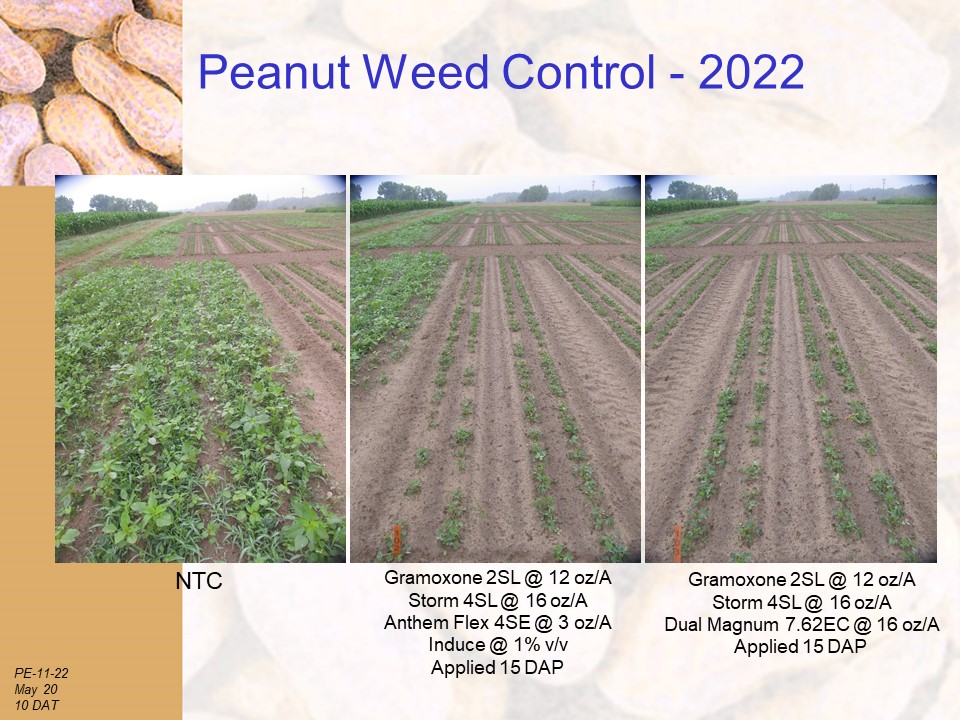
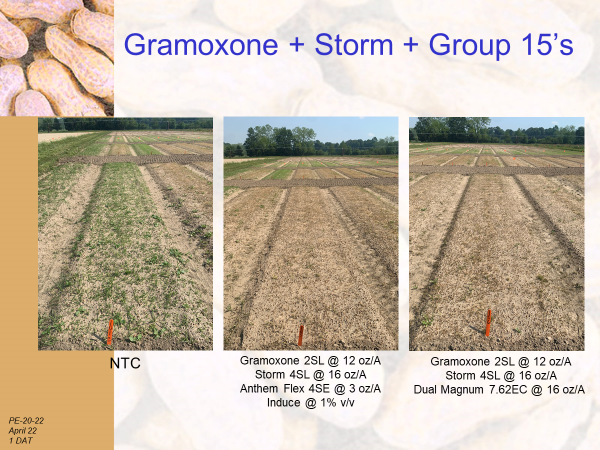
Many peanut growers are in the field right now making "cracking" applications of paraquat (whether they really need it or not?).  I always get tons of questions about product use rates.  Check out these pictures from earlier today.  These are rates I have been testing for years and they work pretty much all the time (when applied to small weeds 1"-3").  Higher rates and later applications, especially in dryland fields, can push a peanut plant's paraquat tolerance to its limits.   


A few other thoughts:

1) If grower wants to use the 3 lb/gal formulation of paraquat (i.e. Helmquat or Gramoxone 3SL), the normal application rate in these tank-mixtures is 8 oz/A (0.1875 lb ai/A).

2) If a grower wants to use Basagran 4SL (bentazon) instead of Storm 4SL (bentazon + acifluorfen), I would suggest using 8 oz/A of Basagran 4SL.

3) If a grower wants to make his own Storm, I would suggest the combination of Ultra Blazer 2SL @ 16 oz/A + Basagran 4SL @ 8 oz/A.

4) I am not a huge fan of using paraquat + Dual Magnum or any other Group 15 herbicide without some Basagran or Storm to cool it down some on the peanut plant.  

5) No adjuvants are needed when Dual Magnum or Outlook are used (i.e. oil-based formulations) but NIS @ 0.25% v/v (1 qt/100 gallons) is suggested when using Anthem Flex, Warrant, or Zidua.  

6) Do I use i.e. and/or italics too much???? (probably)

Monday, May 16, 2022

Monday Musings (May 16) - Prostko

 A few things from the field earlier today:

1) When you get up early, you get to see some cool stuff!

Irrigating under the "blood" moon from last night (6:31 am)

Rainbows for breakfast!  A great omen for the rest of the week (hopefully).

2) Check out the awesome power of a PRE herbicide (activated with moisture).  These are from my grain sorghum plots.  It's 2 weeks after planting and in plots that are not weedy, there were PRE applications of various residual herbicides including one of the following: Aatrex (atrazine); Moccasin II Plus (S-metolachlor); Parallel (metolachlor); Everprex (S-metolachlor); Parallel Plus (atrazine + S-metolachlor); or Cinch ATZ (atrazine + S-metolachlor).  EPOST treatments were applied today. Not sure why growers, especially those with irrigation, are often reluctant to use a PRE??????????


3) Here's what diuron injury looks like on field corn.  It took 3 days before the symptoms started to show up.  I will let you know what happens to final yield.  

4) I am seeing some good weed control results in my soybean plots with Liberty + Enlist One (applied 19 DAP, V1 soybeans, 3-6" Palmer amaranth).


5)  Peanut growers who use Anthem Flex (carfentrazone + pyroxasulfone) in their paraquat "cracking" applications should expect to see more leaf injury (cosmetic) than when Dual Magnum, Outlook, Warrant, or Zidua are used.  Based upon previous UGA research, this injury should not reduce yields.


Monday, May 9, 2022

Monday Musings (May 9) - Prostko

Here are a couple of things to think about based upon recent phone calls/texts and observations from some of my current research projects.

1) If growers observe unexpected/unusual leaf injury/burn after a corn herbicide is applied, it is most likely caused by Valor sprayer contamination.  See below for what this injury looks like and how it could potentially influence corn yields. 


2) When evaluating the potential effects of Liberty on pigweed control, growers should wait at least 7 days before making a final decision on whether or not it worked.  FYI, the colder temperatures this week (< 60 F) will slow down the activity of Liberty for sure.  


3) Peanut growers will be making the decision to spray or not spray an early-postemergence (cracking) herbicide.  If the peanut field was clean at planting and a strong residual herbicide program was used (activated with moisture), it is very likely that a cracking spray will not be needed.  See below (i.e. no weeds in my standard PRE program at 12 DAP):


4) My general recommendations for early-postemergence (cracking) treatments in peanut are as follows:

a) Either paraquat (2 lb/gal) @ 12 oz/A or paraquat (3 lb/gal) @ 8 oz/A + either Storm @ 16 oz/A or Basagran @ 8 oz/A + one Group 15 herbicide [either Anthem Flex @ 3 oz/A or Dual Magnum @ 16 oz/A or Outlook @ 12.8 oz/A or Warrant @ 48 oz/A or Zidua @ 2.5 oz/A (liquid)]. 
Generally, I have no preference between the Group 15's when my suggested PRE/EPOST/POST peanut weed control programs are followed.

b) Add NIS @ 0.25 v/v when using Anthem Flex, Warrant, or Zidua.

c) If need be, growers can make their own Storm (I call it Georgia Storm), by tank-mixing Ultra Blazer (16 oz/A) + Basagran (8 oz/A). This is a slightly different rate than what is applied with current commercial Storm formulation @ 16 oz/A (equivalent to Ultra Blazer @ 11 oz/A + Basagran @ 11 oz/A).

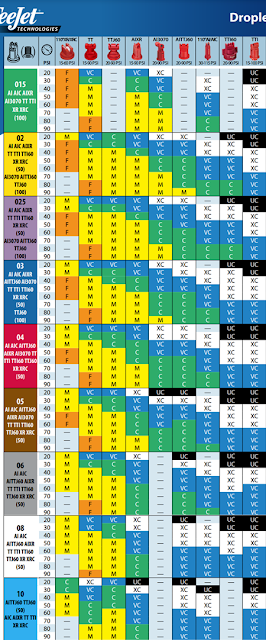
d) Use at least 15 GPA and pressure/nozzle configurations to produce medium to coarse droplets (236-403 microns).  Medium/coarse droplets are yellow and green on this chart.


e) Excessive dust caused by dry weather and tractors driven at Warp Speed 10 will reduce the effectiveness of paraquat.  


NOTE:  Click on pictures for a better view.

Tuesday, April 26, 2022

Across My Plate Today (Prostko)

A couple of interesting weed science items that came across my plate today that I thought you might find helpful:  

1) A grower sent me the following picture of a Bryozoan spp. jamming up his irrigation system (pond).  I reached out to UGA's former aquatic weed specialist (Dr. Gary Burtle) for some help.  A few fun facts about Bryozoans: 1) Bryozoans are microscopic aquatic invertebrates that live in colonies; 2) their presence in ponds is an indicator of good water quality; and 3) control options include copper complexes and stocking ponds with bream (~500/acre).

*****FYI, I am not interested in becoming the new aquatic weed specialist.  My plate is already very full.  Any future calls to me about pond weeds will result in the following: 1) changing my cell phone number to an unlisted number; 2) early retirement; and/or 3) beginning a new career with normal work hours and no throne calls (i.e. Lowes).


2) At every soybean meeting I attend, you will always hear me talking about the need for Georgia farmers to strongly consider the use of metribuzin (PRE).  Metribuzin is cheap, will provide about 21 days of residual pigweed control, and is not a PPO herbicide.  Check out the following picture from some of my soybean plots earlier today.  More than 40+ Palmer amaranth plants/ft2 in the non-treated control (NTC) and ZERO plants where metribuzin was used.


  3)  Metribuzin is available as a solo product and/or as a component of numerous pre-mixes.


4) Growers who want to use metribuzin in soybean must plant a tolerant variety (page 279 of 2022 UGA Pest Control Handbook-Volume 1) and pay very close attention to planting depth (at least 1.5"), rate of application (0.25 lb ai/A), and soil organic matter/texture.