Here are some quick pics from data collected earlier today about spreading (?) dayflower control in peanuts from our strip-plots in Berrien County (Thanks Gentle Ben and Nick Shay!). Generally, these are the same herbicide treatments that I typically recommend for tropical spiderwort/Benghal dayflower control as well. Note that Cadre + Dual Magnum was no bueno! FYI, Broadloom is a generic formulation of Basagran (bentazon) from UPL (https://s3-us-west-1.amazonaws.com/agrian-cg-fs1-production/pdfs/Broadloom_Label1i.pdf).
Tuesday, June 20, 2023
Friday, June 16, 2023
Wet Weather Concerns (Prostko)
Over the past few days, many locations in south Georgia have received significant rainfall (Figure 1).
![]() |
| Figure 1. Georgia Rainfall (June12-June15, 2023) |
A few things to think about:
1) Keep an eye on rain-free periods for postemergence (POST) herbicides. For my crops, these are listed in the UGA Pest Control Handbook (Remarks and Precautions). If I am missing one, please let me know.
3) Residual weed control will likely be compromised (shorter than normal). Applications of additional residual herbicides should be strongly considered (Anthem Flex, Dual Magnum, Outlook, Warrant, Zidua).
4) It is also very likely that some growers will not be able to get back into their fields on a timely basis to make POST herbicide applications. There are no POST herbicides, in any of my crops, that can consistently control a pigweed that is bigger than about 3-4" tall. Thus, applying herbicides to very large weeds (revenge spraying) is a waste of time and money! Hand-weeding, mechanical cultivation, non-selective applicators, and mowing are the only effective options for large weeds.
5) Since applications of POST herbicides will be delayed, experience tells me that many growers will want to apply broadleaf and grass herbicides together. Tank-mixing grass herbicides with broadleaf herbicides (Cadre + Select or 2,4-DB + Select), is labeled/legal but will often result in reduced grass control (~10-20%). Growers can increase the rate of the grass herbicide (within label) but I prefer a split application (grass herbicide first then broadleaf herbicide ~3-5 days later).
Thursday, June 8, 2023
Soil-Applied Dicamba and Peanuts - Uh-Oh! (Prostko)
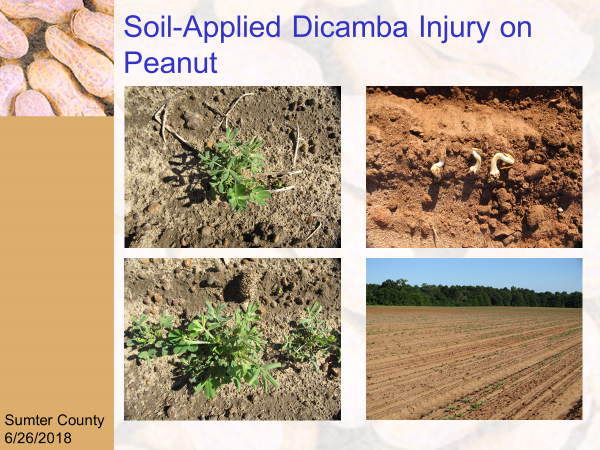
In the past week, I have been involved with 3 field situations where dicamba was inadvertently applied to peanut prior to planting. The results were not good. Dicamba is NOT labeled for preplant use in peanut. With that said, here is all I know about how peanuts respond to soil-applied dicamba.
1) This is what soil-applied dicamba injury on peanut looks like. I had to pinch hit that day for Bill "Bob Never Gave Me a Cool Nickname" Starr. I cannot remember for sure but I I think Bill was hunting Sasquatch in Montana or Wyoming????
2) Field studies that I and several others conducted with preplant applications of dicamba way back in the early 2000's indicated the following:
a) Dicamba at 0.25 lb ae/A (i.e. Clarity @ 8 oz/A or Engenia @ 6.4 oz/A or Xtendimax @ 11 oz/A) applied 7, or 15, or 30 days before planting (DBP) had no effect on yield in 7/7 trials.
b) Dicamba at 0.25 lb ae/A applied 0 DBP (i.e. PRE) caused significant peanut losses in 2/7 field trials. Peanut yield losses in those 2 trials ranged between 36%-76%.
c) Source: Prostko, E.P., T.L. Grey, W.C. Johnson III, D.L. Jordan, W.J. Grichar, B.A. Besler, K.D. Brewer, and E.F. Eastin. 2003. Influence of preplant applications of 2,4-D, dicamba, tribenuron, and tribenuron plus thifensulfuron on peanut. Peanut Science 30:18-22.
3) From Blanchett, B.H., T.L. Grey, E.P. Prostko, and T.W Webster. 2015. The effect of dicamba on peanut when applied during vegetative growth stages. Peanut Science 42:109-120.
4) The most important factors that influence how peanuts will respond to soil-applied dicamba are application rate, soil type, the time interval between application and planting, and irrigation/rainfall. Based upon my experiences with dicamba on peanuts and soybeans, peanuts could be safely planted 14 days + 1" rainfall/irrigation (0.25 lb ae/A) or 28 days +1" irrigation/rainfall (0.5 lb ae/A) after a preplant application of dicamba. But, I need to stress again the fact that dicamba is NOT labeled for preplant use in peanut!
Tuesday, June 6, 2023
Peanut POST's (Prostko)
Here are a couple of quick pics/comments about POST weed control in peanuts based upon research plots that were rated earlier today (June 6). FYI, I did not get any activating moisture for the PRE herbicides for 8-9 days after planting (DAP) due to irrigation system problems. PRE treatments that included Valor still performed very well in this scenario.
Picture #1:
Comments about this picture:
1) No "cracking" herbicides were applied. I prefer to get Cadre out around 30 DAP. Not sand-bagging "cracking" treatments. Gramoxone (paraquat) should be used when needed.
2) My original intention in this test was to just apply Cadre + 2,4-DB + Dual Magnum POST but the lack of a PRE activating moisture event forced me to add some Cobra, especially when PRE's did not include Valor.
3) If a grower has pigweed and is not sure if it is ALS-resistant or not (most likely will be), it would be a good idea to add either Cobra or Ultra Blazer to the Cadre + DB + Dual Magnum tank-mixture. Other than price (Cobra is more expensive by about ~$5-10/A), no difference between Cobra or Ultra Blazer when pigweeds are small (<3"). But, Cobra would be preferred if pigweeds are bigger.
4) Growers can also use Anthem Flex, Outlook, Warrant, or Zidua instead of Dual Magnum. Anthem Flex will cause more leaf burn because it contains a small amount of Aim (carfentrazone). Here is what that looks like 12 DAT.
Picture #3Comments about this picture:
1) Despite the lack of a timely rainfall/irrigation event, Valor performed very well.
2) No "cracking" herbicides were applied. I prefer to get Cadre out around 30 DAP. Not sand-bagging "cracking" treatments. Gramoxone (paraquat) should be used when needed.
3) Really no need for an NIS with Dual Magnum or Outlook (EC formulations). But, need NIS when using Anthem Flex or Warrant.
4) Here is what Cadre + Anthem Flex + 2,4-DB + Induce looks like at 6 DAT.
Picture #4
Sunday, June 4, 2023
Peanut "Cracking" Time Reminders Again (Prostko)
It's that time of year again! Another friendly reminder about peanut "cracking" applications on peanut (a semi-repeat of previous blogs but with 2023 pics).
1) Gramoxone 2SL @ 12 oz/A or Gramoxone 3SL @ 8 oz/A + Storm 4SL @ 16 oz/A + growers' choice of a Group 15 herbicide (i.e. Anthem Flex, Dual Magnum, Outlook, Warrant, Zidua) + NIS @ 0.25% v/v.
2) No need for NIS when either Dual Magnum or Outlook are used.
3) If growers want to make their own Storm, I would suggest Ultra Blazer 2SL @ 16 oz/A + Basagran/Broadloom 4LC @ 8 oz/A. In case you are wondering, Storm 4SL @ 16 oz/A is equivalent to 11 oz/A each of Ultra Blazer and Basagran/Broadloom. So my mix is slightly different (hotter).
4) POST applications no later than 28 days after peanut cracking.
5) Check out 2023 field plots below.
Wednesday, May 17, 2023
Soil-Applied Glyphosate and Peanuts (Prostko)
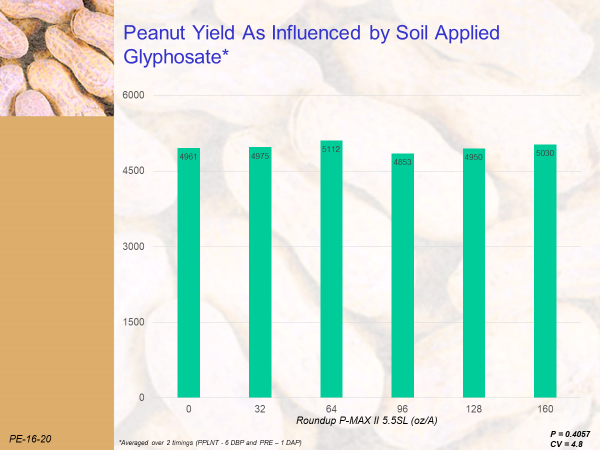
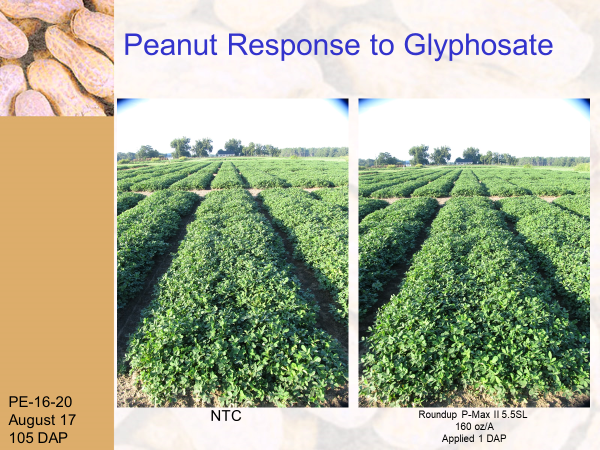
I received a few questions recently about the use of glyphosate prior to planting or shortly after planting peanuts. Many of you have remembered (surprisingly!) what Dr. Culpepper has said about the potential residual effects of higher rates of glyphosate on crops such as transplanted squash, broccoli, and collards. Despite what most of us learned in school many years ago, glyphosate does have soil residual properties but it all depends upon the crop and the application rate. Fortunately, peanut is not a crop that is overly sensitive to glyphosate residues. In 2020, I conducted a field study to prove this point. In this study, I applied Roundup PowerMax II 5.5SL at rates ranging from 32 oz/A to 160 oz/A. Applications were made preplant (6 DBP) or preemergence (1 DAP). Results indicated that glyphosate had no effect on peanut density, height, width, or yield. I do not think that a grower should ever use a 160 oz/A rate (5X) but it does prove a point.
Saturday, May 13, 2023
Valor/Peanut Injury (Again) - Prostko
Last night (May 12), many areas of the state received some rainfall. In some locations, it was more than 1" (Camilla = 1.47"; Ft. Valley = 2.04"; Midville = 2.67", TyTy = 3.14"). Thus, I am pretty sure that my phone will be ringing off the hook this week about Valor injury in peanuts. I have discussed this problem many times before in this blog (June 3, 2013; May 4, 2017; May 21, 2020) so check those other posts out. A few things to remember: 1) This is not a new problem. Valor injury has occurred somewhere in GA since it was first registered way back in 2001; and 2) History and lots of data suggest that most peanut fields suffering from Valor damage will recover without yield losses. Here are some pics and data to help you advise your growers not to panic. Note in the graphs that these plots received more than 8" of rainfall/irrigation within the first 30 DAP and no yield losses were observed even at the 6 oz/A rate. But, I NEVER want any peanut grower to apply a 2X rate Valor on purpose though!