Monday, August 29, 2022
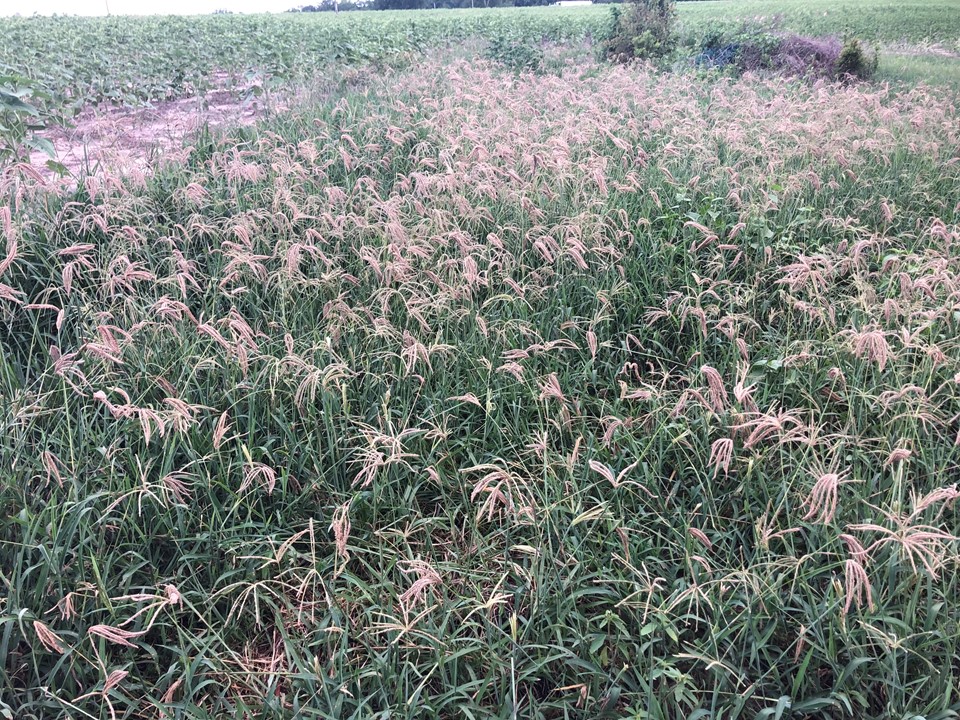
Late-Season Weed Woes (Prostko)
Sunday, July 17, 2022
Sunflower Weed Control and Windmillgrass (Prostko)
A few things you might find interesting:
1) Here's why Valor (flumioxazin) ain't labeled for weed control in sunflowers!
2) Lots of questions lately about windmillgrass aka fingergrass (Chloris spp.). Could be an annual or perennial plant depending upon the species. Supposed to be very sensitive to Roundup (glyphosate), Poast (sethoxydim), Select (clethodim), and Assure II (quizalofop) when applied from seedling to tillering stage of growth but less sensitive to these herbicides when applied at heading [Hennigh et al. 2005. Weed Science 53(3):315-322].
| Windmillgrass photo courtesy of H. McLean (Syngenta). |
Tuesday, July 12, 2022
Goosegrass (Prostko)
Dr. Culpepper recently gave you his 2 cents worth about the control of goosegrass in the most recent UGA Cotton Newsletter - July 2022 (http://www.ugacotton.com/vault/file/July-2022-Cotton-Team-Newsletter.pdf). Thought I would add my 3 cents worth as well since my ears are also bleeding from all the phone calls.
1) The #1 enemies of POST herbicide applications are big weeds and dry weather. If POST graminicides (i.e. Select, Poast, Fusilade, or generics) are applied applied to large plants, they will not work. A flowering goosegrass plant is way too big!!!
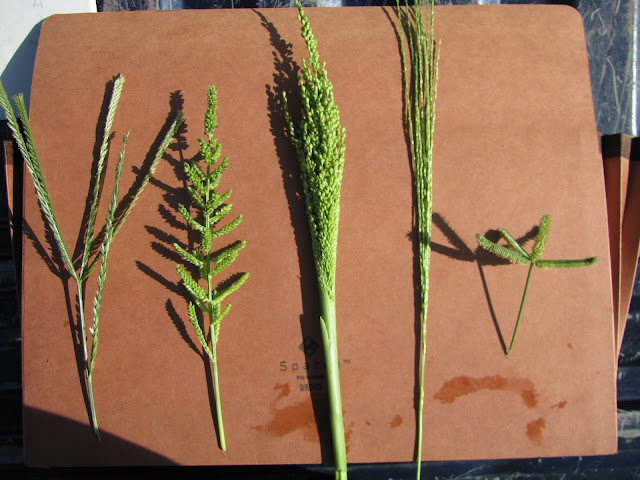
Seed-heads of common annual grasses. From left to right: goosegrass; barnyardgrass: Texas panicum; crabgrass; and crowfootgrass.
2) Check out this greenhouse data from a few years ago. Keep in mind that herbicides are much more active in the greenhouse than in the field. The take home message here is that rate and timing are very important.
3) Growers should expect less grass control with graminicides if applied in tank-mixes with certain fungicides or broadleaf herbicides (Cadre, 2,4-DB). Additionally, grass control can be reduced when graminicides are applied after an application of Cadre has already occurred. The same thing happens with Cadre/Classic/Florida beggarweed.
Monday, June 20, 2022
More Tank-Mix Info/Mixing Order Problems (Prostko)
Here are a few things of interest from last week:
1) Been getting a lot of questions about the use of COC (1% v/v) vs. NIS (0.25% v/v) with Select/Clethodim 2EC on peanut. Generally, clethodim works better when applied with a COC vs. NIS (~10-15% better on some days). But, COC increases crop injury (see below) especially when hot/dry. In the picture below Dyne-Amic (Helena), is a combination of methylated seed oil (soybean) + organosilicone-based NIS. Growers who are overly concerned about peanut injury could use the other formulations of clethodim (Select Max 0.97EC, Tapout 0.97EC, Intensity One 0.97EC) that already include an adjuvant, can be used with a NIS, and are less likely to cause major leaf burn (will still get some leaf burn in this weather).
2) Check out this tank-mix. Ouch!! Class Act NG is a NIS + AMS product (Winfield). Praiz 6F is a generic chlorothalonil (Winfield). Domark 1.9ME (tetraconazole), from Gowan, is labeled for early/late leaf spot, web blotch, and rust. In my opinion, the Class Act NG was not really needed and the rate of Dual Magnum could have been reduced to 16 oz/A. This is a great example of everyone on the planet (me included) not knowing what will happen on any given day when 6 products are tank-mixed together (especially when hot/dry).
Tuesday, June 14, 2022
Cobra or Ultra Blazer for Large Pigweed (Prostko)
A late night text from "The Greatest American County Agent (see below and note chest logo) prompted this blog. For you Millennials reading this, it's a spin on an 1980's TV show called "The Greatest American Hero" (https://en.wikipedia.org/wiki/The_Greatest_American_Hero). This is what you get when you text me at 7:42 pm (Ha Ha! But all kidding aside, I am available 24/7/365 for county agents!)
What are my thoughts about controlling large pigweed in peanuts with Cobra or Ultra Blazer?
1) I do not have a preference between Cobra or Ultra Blazer if the pigweed plants are 2"-4" tall.
2) I do prefer Cobra over Ultra Blazer when plants get bigger than that. But, I would not expect any miracles when plants get larger than 4". For the record, labeled maximum heights for Ultra Blazer (24 oz/A) and Cobra (12.5 oz/A) are 4" tall/6 leaf and 3" tall/6 leaf, respectively.
3) If plants are too big, grower is wasting his time and money on a revenge spray.
4) Other options for controlling large pigweed include hand-weeding, mechanical cultivation, and/or using paraquat in a non-selective applicator (wiper, rope-wick, etc.).
Thursday, June 2, 2022
From the Field - June 2 (Prostko)
A few things for you to consider, fresh from the field:
1) New technologies are great but you can control weeds without it. Nothing beats starting clean, using a strong residual herbicide (activated with moisture) at planting, followed by a timely POST (with more residual). The Palmer amaranth population in these soybean plots is both glyphosate and ALS-resistant and was at an initial density of 40+ plants/sq. ft. Boundary is a combination of metribuzin + s-metolachlor.
2) These peanut weed control programs have worked for me for more than 20+ years (started clean). Once again, I have not observed any differences between Prowl or Sonalan based programs. If you don't like Dual Magnum, you can substitute Anthem Flex, Outlook, Warrant, or Zidua. If you don't like Cadre, use Ultra Blazer or Cobra but lower your weed control expectations, especially if nutsedge and/or sicklepod are present.
3) Don't expect to see much much from Cadre on yellow nutsedge for at least 21 days after application. Cadre must be absorbed by both the leaves and roots for it to be the most effective. POST applications of Cadre in dryland peanut fields that have not gotten much rain after application will likely provide less than optimum control.
4) Tank-mixes of Basagran/Broadloom (bentazon) with Cadre will NOT improve the control of yellow nutsedge. In fact, it could cause antagonism.
Friday, May 20, 2022
"Cracking" Time Again on Peanuts (Prostko)
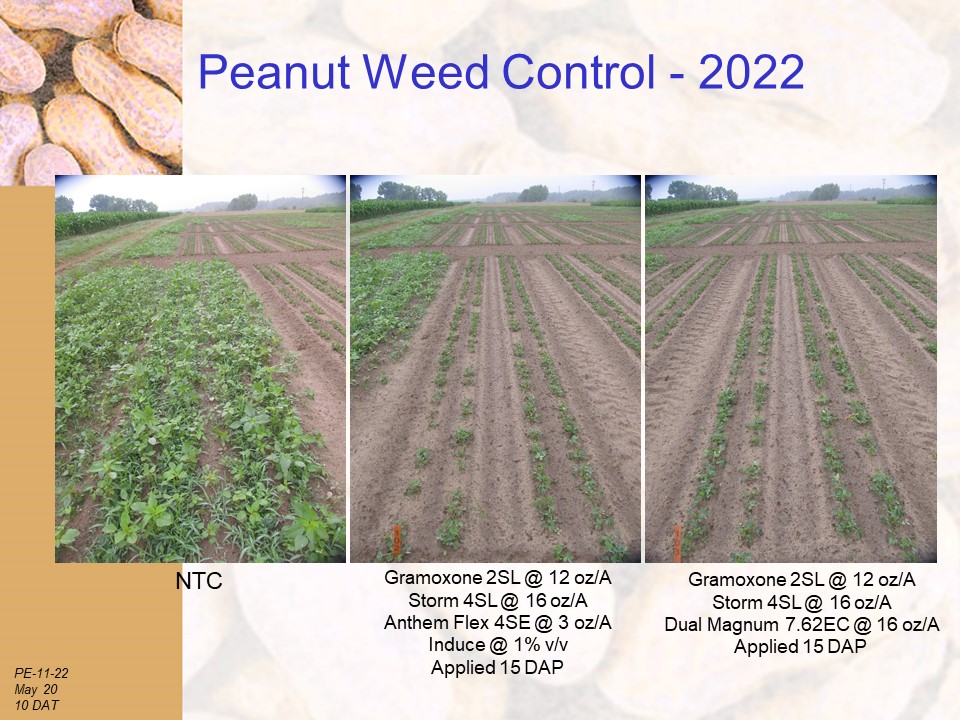
Many peanut growers are in the field right now making "cracking" applications of paraquat (whether they really need it or not?). I always get tons of questions about product use rates. Check out these pictures from earlier today. These are rates I have been testing for years and they work pretty much all the time (when applied to small weeds 1"-3"). Higher rates and later applications, especially in dryland fields, can push a peanut plant's paraquat tolerance to its limits.
2) If a grower wants to use Basagran 4SL (bentazon) instead of Storm 4SL (bentazon + acifluorfen), I would suggest using 8 oz/A of Basagran 4SL.
3) If a grower wants to make his own Storm, I would suggest the combination of Ultra Blazer 2SL @ 16 oz/A + Basagran 4SL @ 8 oz/A.
4) I am not a huge fan of using paraquat + Dual Magnum or any other Group 15 herbicide without some Basagran or Storm to cool it down some on the peanut plant.
5) No adjuvants are needed when Dual Magnum or Outlook are used (i.e. oil-based formulations) but NIS @ 0.25% v/v (1 qt/100 gallons) is suggested when using Anthem Flex, Warrant, or Zidua.
6) Do I use i.e. and/or italics too much???? (probably)