Thursday, April 20, 2023

Week of April 17 - Questions and Answers (Prostko)

Here are some questions (and my answers) that I received this week from various county agents and other clients.

1) If Zidua 4.17SC (pyroxasulfone) is applied postemergence for the residual control of pigweed, annual grasses, and tropical spiderwort, what are the labeled stages of growth for application in field corn, soybean, and peanut?

field corn = spiking up to V8 (this is later than what is currently listed in the 2023 UGA Pest Control Handbook)

soybean = cracking up to V6 (Personally, I would prefer after the soybeans have fully emerged and are growing well)

peanut = cracking up to beginning pod development (R3)

2) How do non-Liberty (glufosinate) tolerant field corn hybrids respond to off-target movement of Liberty?

ASC and and I both think that drift rates are likely around 1/100X and lower.  I do not have any local data from Georgia but check out the following information from LSU.  These data suggest that Liberty rates ≤ 1/50X will cause less than 5% yield losses.


Here is a picture of Liberty injury on field corn.

3) Where can I get information about soybean variety tolerance to metribuzin?

The following table is listed in the 2023 UGA Pest Control Handbook (page 280):


For additional soybean cultivar/metribuzin tolerance information, check out the following from the University of Arkansas:

https://www.uaex.uada.edu/farm-ranch/crops-commercial-horticulture/soybean/2021-Metribuzin-Tolerance-of-Soybean-Varieties.pdf

When considering using metribuzin on soybean, cultivar tolerance is very important but there are other factors to consider as well including application rate, soil texture, OM, pH, and planting depth.  Growers should read metribuzin labels very carefully prior to use.  Here is a list of soybean herbicides than contain metribuzin.


Friday, March 31, 2023

Pre-Plant Burndown Update - Prostko

I am still getting quite a few inquiries about pre-plant burndowns.  Thus, I thought you might be interested in seeing some of the early results of a current pre-plant burndown test located in Tift County.  Special thanks to County Extension Agents Justin Hand/Regan Veal and Wes Shannon (grower) for their cooperation!  A few comments:

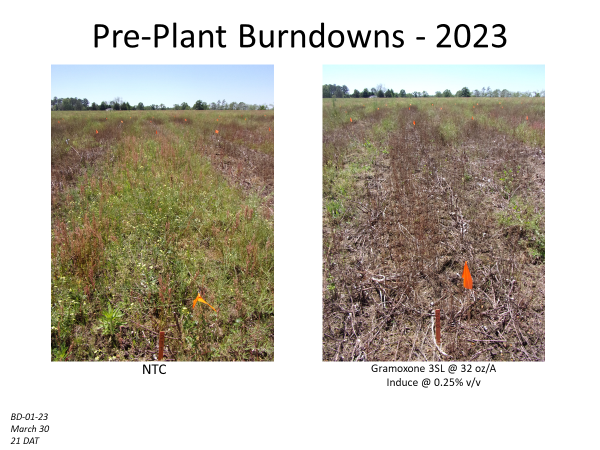
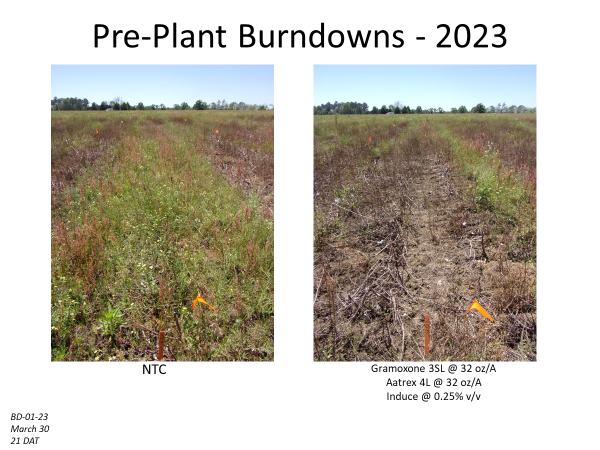
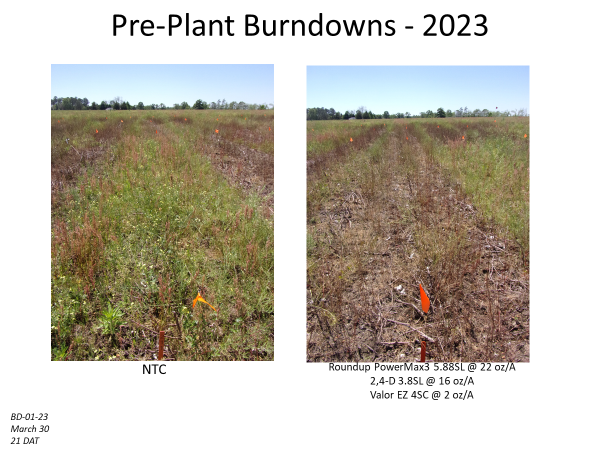
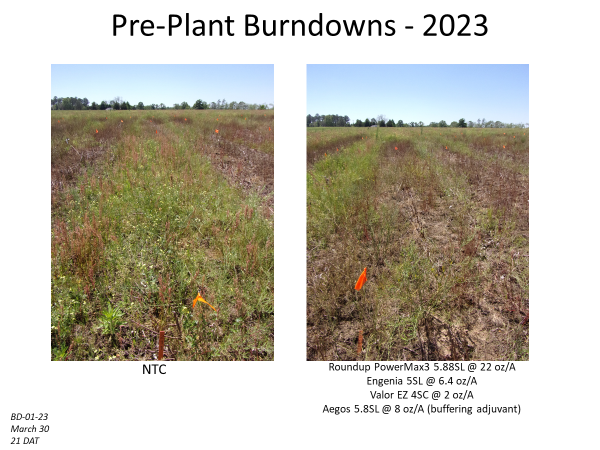
1) All treatments were applied at 7 am on March 9, 2023 (15 GPA with AIXR11002 spray tips).  Main weeds evaluated were wild radish (18-24" tall, flowering) and red sorrel (20-32" tall, flowering).

2) In the first 14 days after treatment (DAT), low temperatures dropped below 45 F for 7 nights.

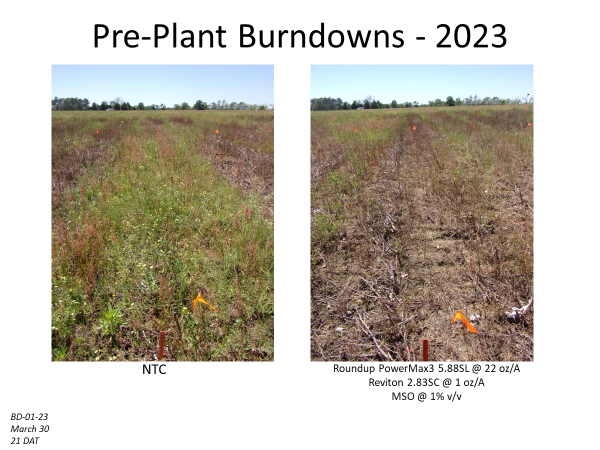
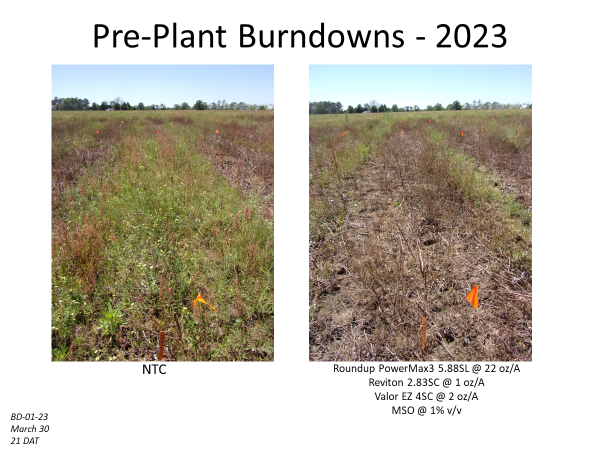
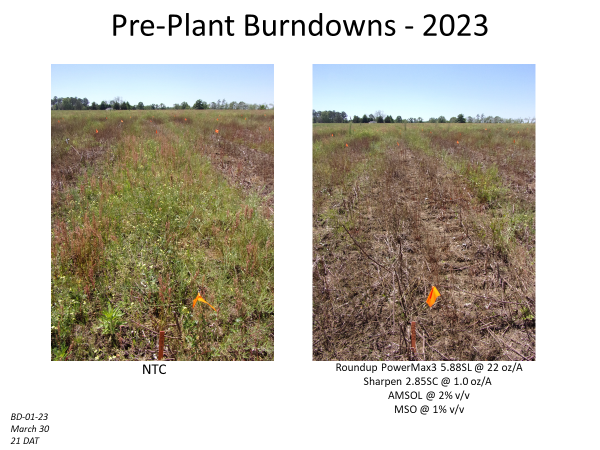
3) Observations and pictures obtained on March 30 (21 DAT) are as follows:

a)  Gramoxone 3SL (paraquat) @ 32 oz/A + Induce (0.25% v/v) was very effective.  No other treatment was more effective in this test.  


b) Any treatments with Roundup PowerMax3 (glyphosate) + either atrazine, 2,4-D or dicamba were not as effective as anticipated based upon my prior experiences.  I suspect that the cold weather after application influenced the effectiveness of these treatments.  Had I known it was going to be so cold, I probably would have bumped up the rate of Roundup slightly and/or used additional adjuvants (i.e. ammonium sulfate and/or crop oil). Maybe these treatments will look better in another week???


c) Roundup + Reviton 2.83SC (tiafenacil) treatments were also very effective.  Reviton label rotation restrictions are as follows: field corn = 0 days; soybean = 7 days; cotton = 7 days (1 oz/A) or 14 days (2 oz/A).  Reviton peanut rotations restrictions are currently in the process of being reduced to 0 days (1 oz/A) and 7 days (2 oz/A).  Estimated cost of Reviton is around $5-6/oz.


d) The surprise treatment of this test was the combination of Roundup + Sharpen (saflufenacil).  I have not talked that much about Sharpen in the past because its main claim to fame has been horseweed.  Horseweed is usually not the major burndown weed in many south Georgia fields (wild radish and cutleaf evening primrose hold that title).  Perhaps I need to re-evaluate my position on this one??? Current label rotations for Sharpen are as follows: field corn/sorghum = 0 days; soybeans = 30 days; cotton = 42 days + 1" rainfall/irrigation; and peanuts = 120 days. 


4) I am not making any "official" recommendations here.  These comments are based upon observations from this test yesterday (21 DAT).  It takes multiple years of data and observations to formulate "official" control recommendations that eventually get added to the UGA Pest Control Handbook.    


Tuesday, March 21, 2023

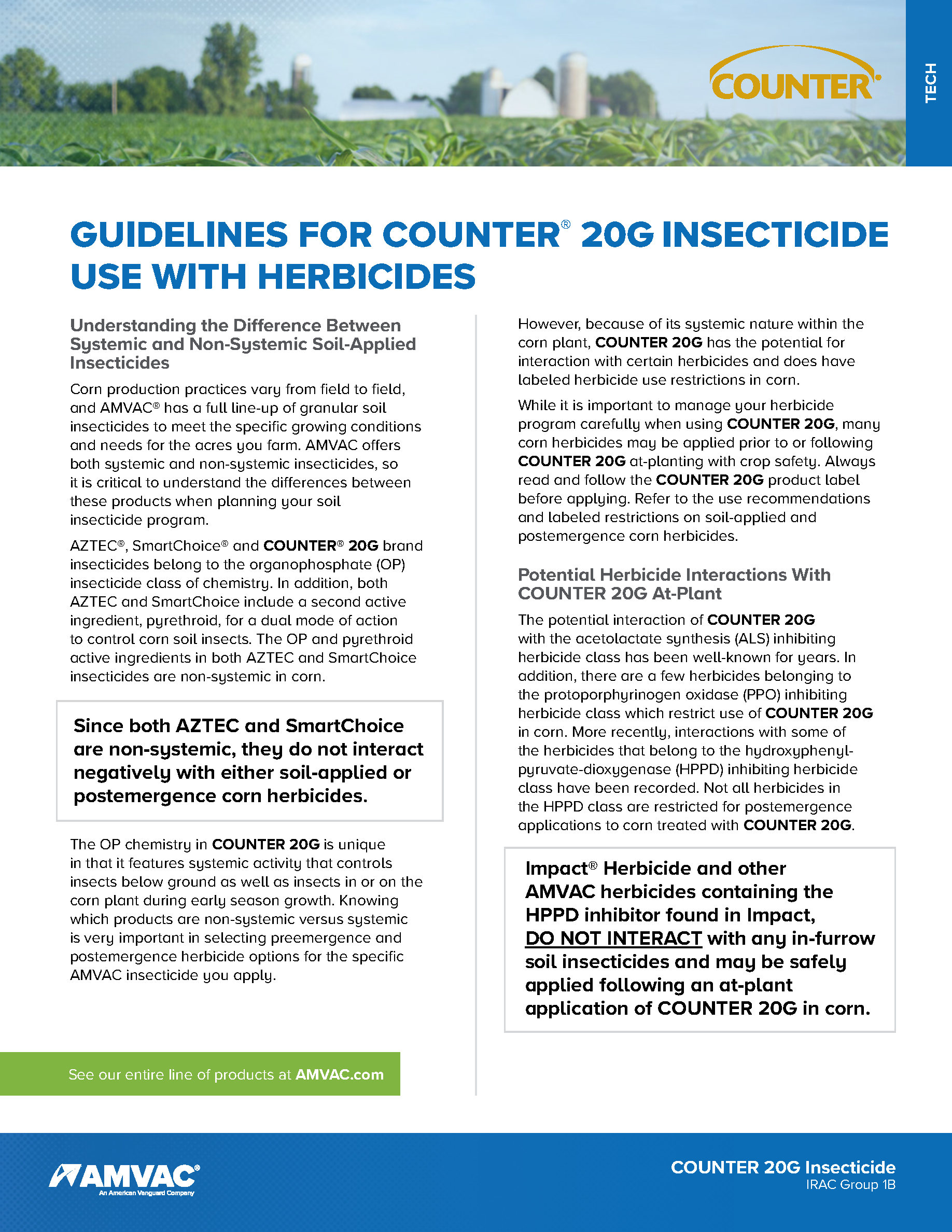
Updated Counter/Herbicide Interactions in Field Corn (Prostko)

In a previous blog (March 9, 2022), I discussed the negative interaction that can occur when Counter (terbufos) or other OP insecticides are used in-furrow and followed by applications of certain herbicides in field corn.  Here is the newest information about the use of Counter and herbicides in field corn from AMVAC® (click on pictures for better clarity).


Monday, March 13, 2023

Cold Weather and Burndowns (Prostko)

Many growers are now in the process of spraying pre-plant burndown herbicides.  Low temperatures over most of Georgia are expected to drop below 40 F over the next three days.  These temperatures are not very favorable for optimum weed control with herbicides such as Roundup (glyphosate) or Gramoxone (paraquat).  Thus, you might want to advise your growers to hold off for a few days until temperatures warm up again (above 40 F but I would prefer warmer).  Here is some data to chew on:

1) From some older air temperature research (47 F, 56 F, 65 F, 75 F, and 87 F) conducted by my colleague at Michigan State University, Dr. Christy Sprague:

a) Air temperatures had very little effect on the control of common chickweed with Roundup.  However, common chickweed control at lower temperatures was compromised with Gramoxone (only 70% control at 47 F).

b) Air temperature had a significant effect on the control of henbit with both Roundup and Gramoxone.  When applied at 47 F, henbit control was < 30% with both herbicides.

2) From Harre et al. (2021) in Weed Technology 35:279-288:

a) Shoot biomass reduction of horseweed and purple deadnettle was 34% and 28% greater, respectively, when paraquat was applied at day/night temperatures of 81/61 F than when applied at 64/55 F.


Wednesday, January 25, 2023

Brake Peanut Label (Prostko)

I just received the news earlier today that Brake (fluridone) has received EPA approval for use in the 2023 peanut crop.  After final label approval from the GA Dept. of Agriculture, it should be a done deal.  I have been working with this herbicide for 10+ years and am very glad that peanut growers will have another tool in their toolbox.  Here are a few questions/answers that you might find helpful when talking about Brake with your growers: 

1) Who is the manufacturer of Brake herbicide?

Brake was developed by SePRO Ag (https://ag.sepro.com)

2) What is the active ingredient in Brake?

The active ingredient in Brake is fluridone.  Fluridone is also sold in the aquatic weed control market under the trade name of Sonar.  Fluridone was first registered for aquatic use in 1986.

3) What is the mode of action (MOA) of Brake?

Brake is a WSSA/HRAC Group 12 herbicide.  Group 12 herbicides block carotenoid biosynthesis in susceptible plants by inhibiting the phytoene desaturase enzyme.  This ultimately leads to the destruction of chlorophyll and membrane lipids.  Brake has the same MOA as Solicam/Zorial (norflurazon) which has been labeled in peanut since 1993 but has not been used that much (at least in my 26 year peanut career).  

4) How long has UGA been testing Brake for use in peanut?

Initial research on the use of fluridone in peanuts began in 2013.

5) What rate of Brake should be applied in peanut?

Brake 1.2LC can be applied preplant (14 days) or preemergence at 12 oz/A (0.113 lb ai/A) but no later than 36 hours after planting.  We are collecting additional data with the goal of increasing this timeline after planting (but before cracking/emergence).  Brake needs at least 0.5" of rainfall or irrigation to be properly activated.  Peanut seed must be planted at least 1.5" deep.

6) Is Brake a stand alone product?  

NO! Brake should always be applied in combination with a grass herbicide (i.e. Dual Magnum, Outlook, Prowl, Sonalan, or Warrant) and Strongarm (when rotations permit). It can also be tank-mixed with Valor.


Figure 1.  Comparison of a Valor-based peanut weed control program and a Brake-based peanut weed control program, Ty Ty, GA (2022)

7) What peanut cultivars has Brake been tested on?

Brake has been tested on the following peanut cultivars in Georgia: GA-06G; GA-16HO; GA-18RU; GA-20VHO; GA-12Y; AUNPL-17; TifNV High O/L; and FloRun 331.  In some tests, GA-16HO has exhibited more leaf injury (bleaching) but yields were not reduced. Injury from Brake is more likely to occur when excessive rates are used and when environmental conditions are unfavorable (i.e. cold and wet).

Figure 2.  Brake (fluridone) injury on peanut. 

8) How much will Brake cost?

Estimated cost for 12 oz/A will be somewhere around $16.

9) What are the crop rotation restrictions for Brake?

Current crop rotation restrictions for Brake are as follows: cotton = 0 months; soybean = 2 months; wheat/barley/rye = 8 months (5 months if grown as cover and not harvested); corn/sorghum = 10 months; and tobacco/sunflower = 18 months.

10) Why would a grower consider using Brake in a peanut weed control program?

a) Brake adds an additional herbicide MOA to the peanut weed control toolbox which is extremely beneficial for resistance management.

b) Brake is very effective on Palmer amaranth.  

11) A copy of the following Supplemental Label must be in the possession of the user at the time of application (after GA Dept. of AG approval):


Wednesday, January 18, 2023

Tillage/Burial Depth Effects on Weed Emergence (Prostko)

    As Dr. Culpepper and I have begun our annual winter weed tour around most of Georgia, one of the many things you will here us discuss is starting weed-free (clean) at planting using a combination of practices such as tillage, cover crops, and/or herbicides.  The use of cover crops and tillage will vary by grower.  There are risks/rewards to both of these practices.  

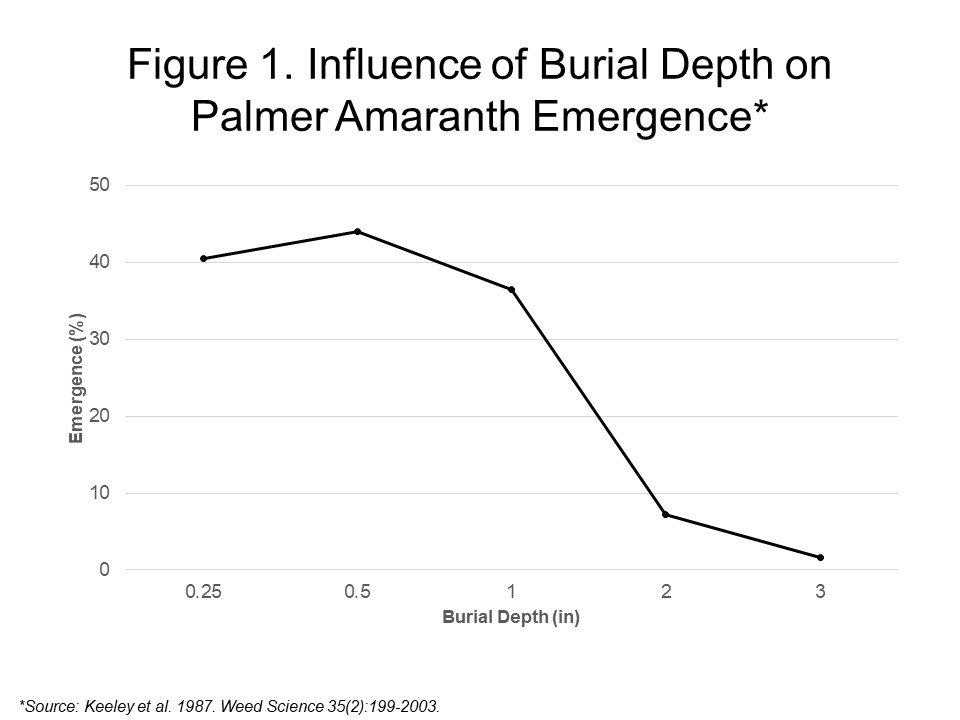
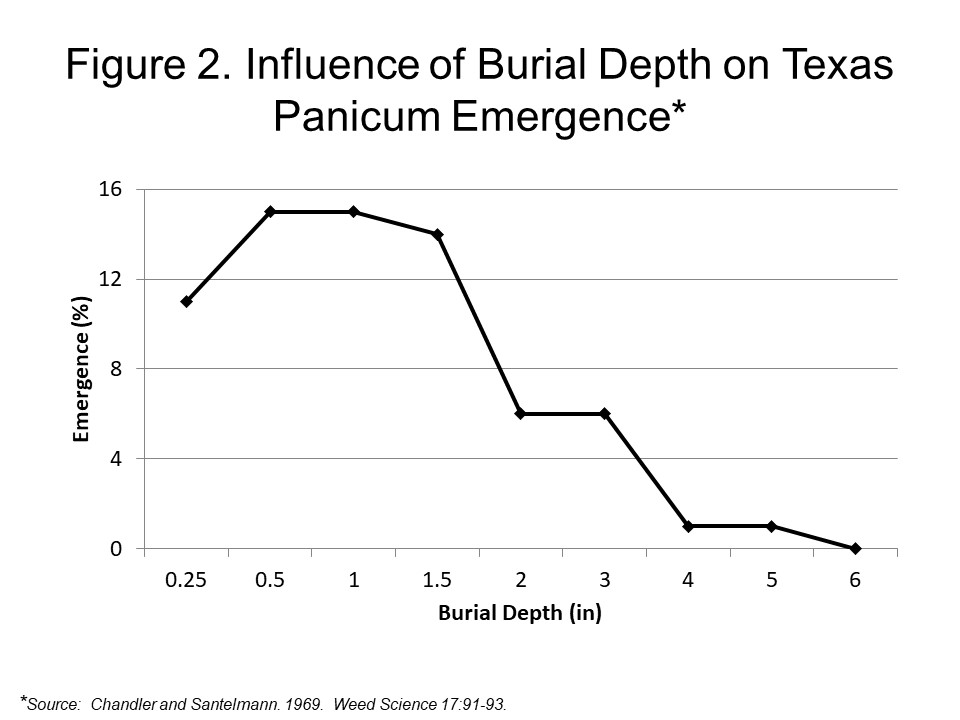
    The question you might often get asked by growers is "Why/how does tillage influence weed control?"  The simple answer is that when soils are not disturbed with tillage every once in awhile, weed seeds accumulate at or near the soil surface.  Generally, most annual weeds will readily germinate and emerge from the 0"-2" soil depth. When those seeds are buried deeper in the soil profile with inversion tillage (i.e. moldboard plow), it is more difficult for plants that develop from those seeds to emerge.  Of course seed size matters and plants that have larger seeds have greater potential to emerge from deeper burial depths than plants with smaller seeds (more energy in bigger seeds).  If you are interested in some data about the effects of weed seed burial depth on emergence, check out the following graphs.  The general trend in these graphs is that more weed emergence occurs at shallow burial depths and less emergence occurs at greater burial depths (note that a couple of these graphs have burial depths in cm and remember that 2.5 cm = 1 inch).


    Another thing to remember is that moldboard plowing is not a practice that should be done every year.  A general rule of thumb would be to plow once every 3 to 4 years which fits very nicely with our peanut rotations.  You might recall seeing this Georgia data that illustrates the effects of both burial depth and time on Palmer amaranth seed viability. Palmer amaranth seed viability was reduced to 20% or less when buried for 36 months.  


    Our main message to growers for years has been to use as many weed management practices as possible.  These include tillage, cover crops, narrow row spacing, herbicides, and/or hand-weeding.  Herbicides alone are not enough!

Monday, August 29, 2022

Late-Season Weed Woes (Prostko)

A few things to consider based upon my texts/e-mails/telephone calls over the last few days or so: 

1) Field corn growers should be reminded that post-harvest (if it ever stops raining in some locations) is a great time of the year to get a handle on Benghal dayflower/tropical spiderwort.  Herbicides of choice include Gramoxone (paraquat), Aim (carfentrazone) and/or 2,4-D.  Check out page 74 of the 2022 UGA Pest Control Handbook for more info and peruse this old poster (click on pics to get a better/clearer view).


2) My preferred pre-harvest treatment for late-season morningglories and other junk in field corn is a combination of Roundup (glyphosate) + Aim (carfentrazone).  Check out page 73 of the 2022 UGA Pest Control Handbook.  This combination will not magically remove running morningglory plants from the field but it will dry them out enough to facilitate an easier harvest.


3) Peanut growers can also use Aim for late-season morningglory dessication about 7 days prior to digging.  Check out page 224 of the 2022 UGA Pest Control Handbook.  Remember, Aim is not very effective on smallflower morningglory and will cause some cosmetic (i.e. non-yield robbing) peanut leaf injury.


4) Here is yet another example of the awesome power of an activated PRE herbicide from my field plots earlier today.  At 20 DAT, excellent control of Palmer amaranth with all formulations of flumioxazin.


5) I am currently in the process of updating my sections (field corn, soybean, grain sorghum, canola, English/winter pea, pearl millet, peanut, sunflowers, and sugarcane) of the UGA Pest Control Handbook for 2023. If you have any comments/suggestions or have found some errors in the 2022 edition, please let me know ASAP.  Also, I will be adding a new section for sesame for those that are interested.