Wednesday, May 17, 2023

Soil-Applied Glyphosate and Peanuts (Prostko)

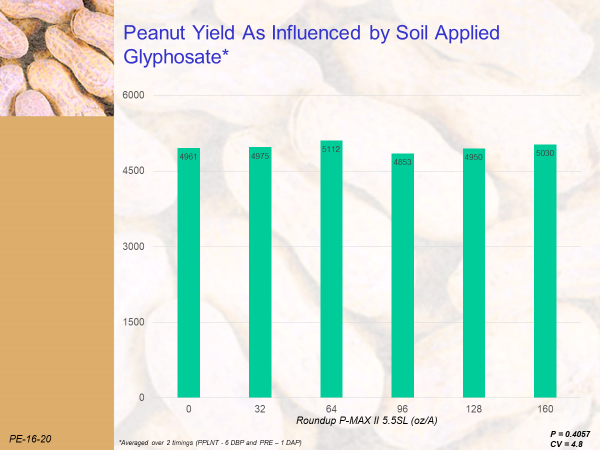
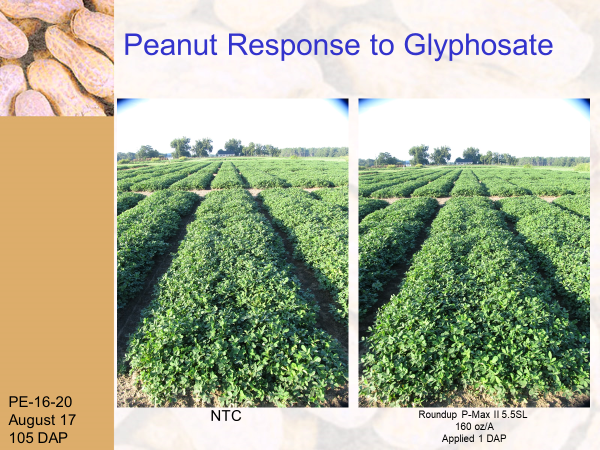
I received a few questions recently about the use of glyphosate prior to planting or shortly after planting peanuts.  Many of you have remembered (surprisingly!) what Dr. Culpepper has said about the potential residual effects of higher rates of glyphosate on crops such as transplanted squash, broccoli, and collards. Despite what most of us learned in school many years ago, glyphosate does have soil residual properties but it all depends upon the crop and the application rate.  Fortunately, peanut is not a crop that is overly sensitive to glyphosate residues.  In 2020, I conducted a field study to prove this point.  In this study, I applied Roundup PowerMax II 5.5SL at rates ranging from 32 oz/A to 160 oz/A.  Applications were made preplant (6 DBP) or preemergence (1 DAP).  Results indicated that glyphosate had no effect on peanut density, height, width, or yield.  I do not think that a grower should ever use a 160 oz/A rate (5X) but it does prove a point.


Saturday, May 13, 2023

Valor/Peanut Injury (Again) - Prostko

Last night (May 12), many areas of the state received some rainfall.  In some locations, it was more than 1" (Camilla = 1.47"; Ft. Valley = 2.04"; Midville = 2.67", TyTy = 3.14").  Thus, I am pretty sure that my phone will be ringing off the hook this week about Valor injury in peanuts.  I have discussed this problem many times before in this blog (June 3, 2013; May 4, 2017; May 21, 2020) so check those other posts out.  A few things to remember: 1) This is not a new problem.  Valor injury has occurred somewhere in GA since it was first registered way back in 2001; and 2) History and lots of data suggest that most peanut fields suffering from Valor damage will recover without yield losses.  Here are some pics and data to help you advise your growers not to panic.  Note in the graphs that these plots received more than 8" of rainfall/irrigation within the first 30 DAP and no yield losses were observed even at the 6 oz/A rate.  But, I NEVER want any peanut grower to apply a 2X rate Valor on purpose though!


Sunday, May 7, 2023

Herbicide Name Recognition (Prostko)

Recently heard of a major whoopsie due to some communication errors.  There are least 3 herbicides floating around Georgia with similar trade names but have very different uses.  Please encourage your growers and dealers to pay close attention to what is being sprayed.


Thursday, May 4, 2023

Field Corn Weed Control Pictures - 2023 (Prostko)

1) Thought you might be interested in seeing the following pictures from my field corn weed control plots taken over the last week.  For more specific information about these herbicides, check out the 2023 UGA Pest Control Handbook (pages 64-88).  FYI, this is what I am doing when you try to call me between 6 am-9 am.


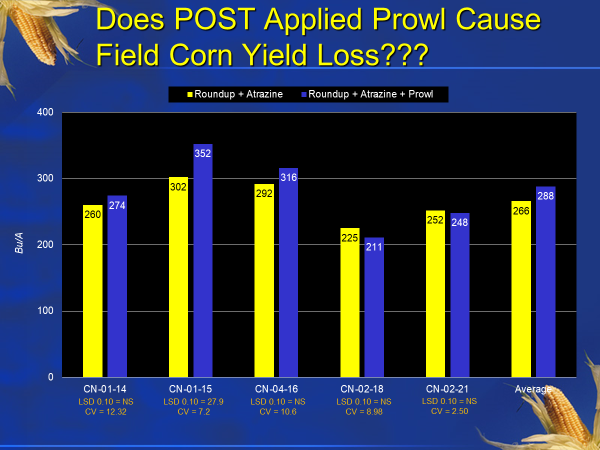
2) Question #1: Why do I have Prowl H20 3.8SC (pendimethalin) mixed with everything in these treatments?

Texas panicum/buffalograss/bullgrass is one of the most common annual grass weeds in Georgia field corn.  Put very simply, Prowl provides the best residual control of Texas panicum.  If growers are concerned about potential crop injury from Prowl, other residual annual grass control options include Anthem Maxx (pyroxasulfone + fluthiacet), Dual Magnum (s-metolachlor), Outlook (dimethenamid-P), Warrant (acetochlor), and Zidua (pyroxasulfone).  Of these, Anthem Maxx and Zidua are slightly better on Texas panicum (but neither are as good as Prowl).  FYI, Prowl should NEVER be applied PPI or PRE in Georgia field corn, only POST (labeled up to 30" tall/V8).

3) Question #2:  I have heard that Prowl will cause root damage and yield loss when applied to field corn?

A long time ago in a galaxy far far away, Prowl was used as an EPOST (spiking) treatment in combination with atrazine.  Back then, this was about the only way to get reasonable control of Texas panicum.  In that scenario, root pruning was more likely to occur especially when corn was planted <1.5" deep and furrow closure was incomplete.  Delaying Prowl applications allows the corn plant to develop a deeper root system (but still a good idea to plant at least 1.5" deep and have complete furrow closure though).  For many years, I have been applying Prowl POST with various herbicides and have never observed any significant yield losses.


Thursday, April 20, 2023

Week of April 17 - Questions and Answers (Prostko)

Here are some questions (and my answers) that I received this week from various county agents and other clients.

1) If Zidua 4.17SC (pyroxasulfone) is applied postemergence for the residual control of pigweed, annual grasses, and tropical spiderwort, what are the labeled stages of growth for application in field corn, soybean, and peanut?

field corn = spiking up to V8 (this is later than what is currently listed in the 2023 UGA Pest Control Handbook)

soybean = cracking up to V6 (Personally, I would prefer after the soybeans have fully emerged and are growing well)

peanut = cracking up to beginning pod development (R3)

2) How do non-Liberty (glufosinate) tolerant field corn hybrids respond to off-target movement of Liberty?

ASC and and I both think that drift rates are likely around 1/100X and lower.  I do not have any local data from Georgia but check out the following information from LSU.  These data suggest that Liberty rates ≤ 1/50X will cause less than 5% yield losses.


Here is a picture of Liberty injury on field corn.

3) Where can I get information about soybean variety tolerance to metribuzin?

The following table is listed in the 2023 UGA Pest Control Handbook (page 280):


For additional soybean cultivar/metribuzin tolerance information, check out the following from the University of Arkansas:

https://www.uaex.uada.edu/farm-ranch/crops-commercial-horticulture/soybean/2021-Metribuzin-Tolerance-of-Soybean-Varieties.pdf

When considering using metribuzin on soybean, cultivar tolerance is very important but there are other factors to consider as well including application rate, soil texture, OM, pH, and planting depth.  Growers should read metribuzin labels very carefully prior to use.  Here is a list of soybean herbicides than contain metribuzin.


Friday, March 31, 2023

Pre-Plant Burndown Update - Prostko

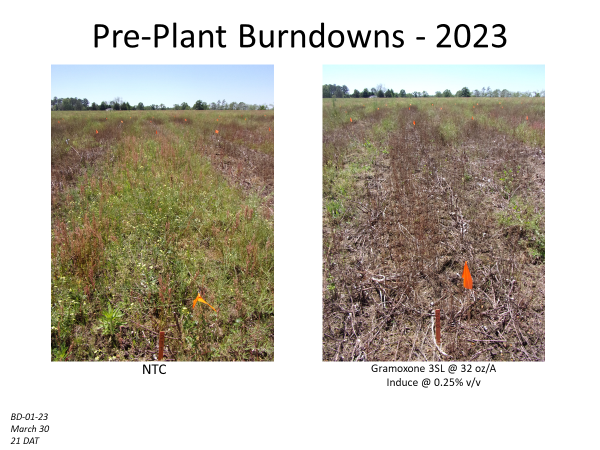
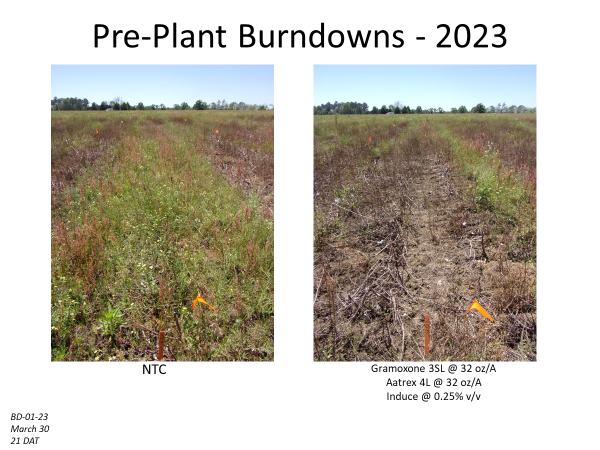
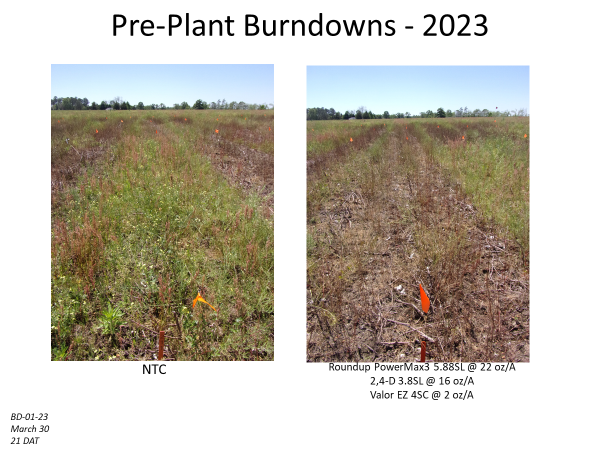
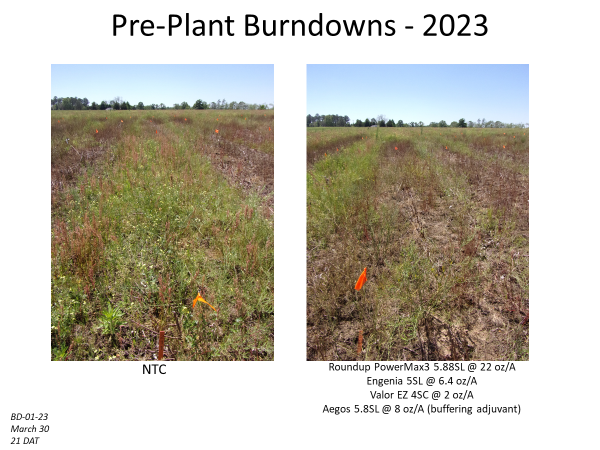
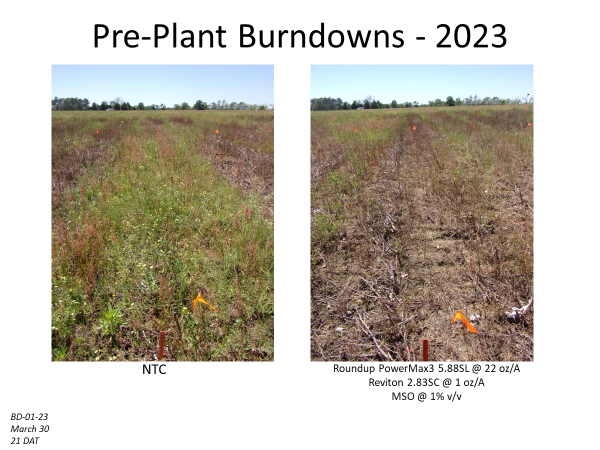
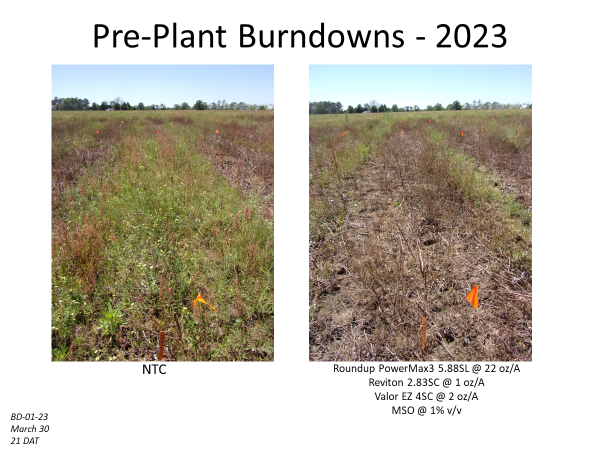
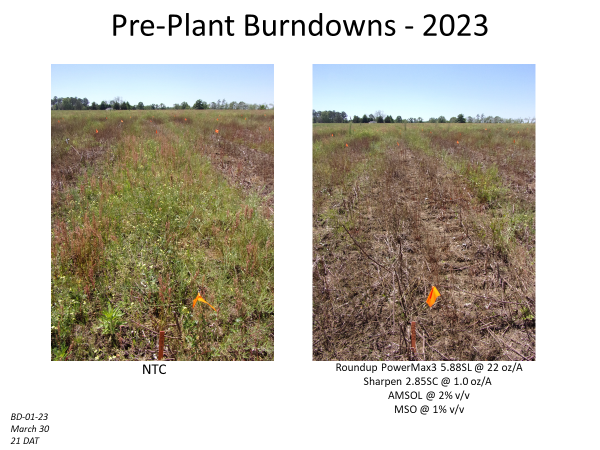
I am still getting quite a few inquiries about pre-plant burndowns.  Thus, I thought you might be interested in seeing some of the early results of a current pre-plant burndown test located in Tift County.  Special thanks to County Extension Agents Justin Hand/Regan Veal and Wes Shannon (grower) for their cooperation!  A few comments:

1) All treatments were applied at 7 am on March 9, 2023 (15 GPA with AIXR11002 spray tips).  Main weeds evaluated were wild radish (18-24" tall, flowering) and red sorrel (20-32" tall, flowering).

2) In the first 14 days after treatment (DAT), low temperatures dropped below 45 F for 7 nights.

3) Observations and pictures obtained on March 30 (21 DAT) are as follows:

a)  Gramoxone 3SL (paraquat) @ 32 oz/A + Induce (0.25% v/v) was very effective.  No other treatment was more effective in this test.  


b) Any treatments with Roundup PowerMax3 (glyphosate) + either atrazine, 2,4-D or dicamba were not as effective as anticipated based upon my prior experiences.  I suspect that the cold weather after application influenced the effectiveness of these treatments.  Had I known it was going to be so cold, I probably would have bumped up the rate of Roundup slightly and/or used additional adjuvants (i.e. ammonium sulfate and/or crop oil). Maybe these treatments will look better in another week???


c) Roundup + Reviton 2.83SC (tiafenacil) treatments were also very effective.  Reviton label rotation restrictions are as follows: field corn = 0 days; soybean = 7 days; cotton = 7 days (1 oz/A) or 14 days (2 oz/A).  Reviton peanut rotations restrictions are currently in the process of being reduced to 0 days (1 oz/A) and 7 days (2 oz/A).  Estimated cost of Reviton is around $5-6/oz.


d) The surprise treatment of this test was the combination of Roundup + Sharpen (saflufenacil).  I have not talked that much about Sharpen in the past because its main claim to fame has been horseweed.  Horseweed is usually not the major burndown weed in many south Georgia fields (wild radish and cutleaf evening primrose hold that title).  Perhaps I need to re-evaluate my position on this one??? Current label rotations for Sharpen are as follows: field corn/sorghum = 0 days; soybeans = 30 days; cotton = 42 days + 1" rainfall/irrigation; and peanuts = 120 days. 


4) I am not making any "official" recommendations here.  These comments are based upon observations from this test yesterday (21 DAT).  It takes multiple years of data and observations to formulate "official" control recommendations that eventually get added to the UGA Pest Control Handbook.    


Tuesday, March 21, 2023

Updated Counter/Herbicide Interactions in Field Corn (Prostko)

In a previous blog (March 9, 2022), I discussed the negative interaction that can occur when Counter (terbufos) or other OP insecticides are used in-furrow and followed by applications of certain herbicides in field corn.  Here is the newest information about the use of Counter and herbicides in field corn from AMVAC® (click on pictures for better clarity).