You might recall that I provided you with some general information about spray adjuvants in a December 11, 2023 UGA Weed Science blog post. I was not aware of (or more likely forgot) that there is an Adjuvant Certification Program spearheaded by the Council of Producers and Distributors of Agrotechnology (CPDA). Adjuvants that have this certification have met 17 benchmark qualifications of a consistent and quality adjuvant. More information and a complete list of CPDA certified adjuvants can be found at https://cpda.com/adjuvant-certification-history-2/.

Weed Science Information (Row Crops/Vegetables) for County Extension Agents
Saturday, February 24, 2024
Thursday, February 22, 2024
Ryegrass Control/Reviton-Peanut Rotation Restriction Change (Prostko)
A few things you might be interested in:
1) Lately, I have received a few questions about controlling Italian/annual ryegrass in preplant burndown situations. Assuming resistance is not an issue, glyphosate can be effective but remember that rate and timing are very import (Figure 1). If you suspect that glyphosate-resistance (GR) is an issue, check out page 85 of the 2024 UGA Pest Control Handbook. On the bottom of page 85, I have more detailed information about controlling GR-ryegrass.
https://secure.caes.uga.edu/extension/publications/files/pdf/SB%2028-15_2.PDF
 |
| Figure 1. Ryegrass Control with Roundup WeatherMax at Different Rates and Stages of Growth. 2) Via a FIFRA Section 24(c) label, the crop rotation restriction for peanut in Georgia following an application of Reviton (tiafenacil) has been reduced to 0 days (1 oz/A ) and 7 days (2 oz/A). Refer to the 24(c) label below. Check out the February 7, 2022 and March 31, 2023 posts on the UGA Weed Science Blog for some earlier comments about Reviton. |
 |
| Figure 2. Section 24(c) Label for Reviton (tiafenacil) in Georgia |

Wednesday, January 31, 2024
2024 Peanut Herbicide Prices, Field Corn Hybrid Herbicide Tolerance Guides - Prostko
1) Thought you might be interested in the current prices of peanut herbicides. These prices were obtained by averaging numbers from at least 4 local retailers. Also, need to realize that every grower will likely pay a different price than listed below based upon many factors (probably lower).
Anthem Flexx = $621/gal; Basagran = $60/gal; Brake = $187/gal; Butyrac 1.75SL (2,4-DB) = $21/gal; Cadre = $250/gal; Cobra = $181/gal; Dual Magnum = $69/gal; Gramoxone 3SL = $40/gal; Outlook = $134/gal; Prowl H2O = $49/gal; Select Max = $92/gal; Sonalan = $50/gal; Storm = $90/gal; Strongarm = $756/lb; Ultra Blazer = $46/gal; Valor EZ = $461/gal; Warrant = $30/gal; Zidua SC = $710/gal.
Using these numbers then ......
Sonalan 3EC @ 32 oz/A + Valor EZ 4SC @ 3 oz/A + Strongarm 84WG @ 0.225 oz/A (PRE) fb Cadre 2AS @ 4 oz/A + Dual Magnum 7.62EC @ 16 oz/A + Butyrac 1.75SL @ 16 oz/A (POST) = $53.01/A
2) Check out the most recent editions of the field corn hybrid herbicide tolerance information from Pioneer and Dekalb. Always a good idea to double-check BEFORE spraying.
Amides: Dual Magnum, Outlook, Warrant
Benzoic Acid/Phenoxy: 2,4-D, dicamba
Isoxazole: Callisto, Laudis, Impact
Sulfonylurea: Accent, Revulin Q, Sandea, Steadfast Q
Pioneer:

Dekalb:

Monday, December 11, 2023
Herbicide Adjuvants (Prostko)
At the recent UGA Weed Science Update (12/06/23), Cale Cloud from Grady County asked me if I could talk about herbicide adjuvants. Since I had my talks already prepared, I did not have the time to go into this interesting and very important topic. Here are few things for you to consider:
1) There are numerous adjuvants in the market. Thus, almost impossible for UGA weed scientists to adequately test all of them. I could have spent my whole career just testing adjuvants.
2) Generally, adjuvants can be put into 3 categories including non-ionic surfactants (NIS), oils [crop oil concentrates (COC) or methylated seed oils (MSO)], and fertilizers [usually dry or liquid ammonium sulfate (AMS) or liquid urea-ammonium-nitrate (UAN)].
3) All POST herbicide labels will have a section on recommended adjuvants.
4) Generally (not always), COC/MSO adjuvants will cause more crop injury and provide slightly better weed control than NIS adjuvants.
5) Many COC's are actually made from petroleum oils while MSO's are made from vegetable oils (soybean or sunflower). Both types contain 80-85% oil + 15-20% surfactant. High surfactant oil concentrates (HSOC) contain at least 50% oil + 25-50% surfactant.
6) In my own herbicide testing program, I routinely use Induce (NIS) or Agri-Dex (COC) from Helena unless somebody asks/provides something special. For over 25 years, both of these have worked just fine for me.
Induce: https://s3-us-west-1.amazonaws.com/agrian-cg-fs1-production/pdfs/Induce_Label1g.pdf
Agri-Dex: https://s3-us-west-1.amazonaws.com/agrian-cg-fs1-production/pdfs/Agri-Dex_Label1i.pdf
7) Historically, North Dakota State University (NDSU) has been one of the leading land-grants that regularly tests herbicide adjuvants. I included some very good information about adjuvants from the 2023 NDSU Weed Control Guide (W253-23) in the e-mail that I sent to you regarding this specific blog. This info would make a great edition to your "truck" reference materials.
2023 NDSU Weed Control Guide (https://www.ndsu.edu/agriculture/sites/default/files/2022-12/223214_Weed_Color.pdf)
8) Another good resource for herbicide adjuvants is the Compendium of Herbicide Adjuvants. This publication used to be updated yearly but is no longer. The latest edition (2016) can be found at the following web-address: https://mssoy.org/uploads/files/herb-adjuvants-purdue-siu.pdf
9) If someone is using an adjuvant in your county that you would like to see researched more thoroughly, I can try to fit it into my testing program. This may or may not happen given my time and space constraints.
Friday, September 29, 2023
Post-Harvest Weed Control Questions (Prostko)
Still getting a few calls about post-harvest weed control. Here are a few questions and answers for you regarding post-harvest weed management:
1) What's the best option to control volunteer corn (up to 12" tall)?
Select Max 0.97EC @ 6 oz/A or Select 2EC (clethodim) @ 4 oz/A (or generic equivalents) + COC @ 1% v/v. I have never had much success controlling volunteer corn with either Liberty (glufosinate) or Gramoxone (paraquat). Don't forget that many of the corn hybrids grown in Georgia today are RR+LL. The plant-back restriction for wheat after clethodim is 30 days. A hard freeze also works well with no plant-back restrictions.
2) Can you control Benghal dayflower/tropical spiderwort with 1 herbicide application?
NO! 2 applications (14 days apart) of either Gramoxone, Aim (carfentrazone), or 2,4-D will be required. Dicamba is NOT recommended for the control of this weed.
3) What is the plant back restriction for wheat after an application of dicamba?
All depends upon the application rate (0.25 lb ae/A = 15 days; 0.50 lb ae/A = 30 days).
4) What is your favorite post-harvest treatment?
I have had good success controlling many post-harvest weeds in my field corn plots, including volunteer corn, with the combination of Gramoxone + Tricor (metribuzin). But, small grains are not a viable rotational crop option after this one. Gramoxone + Tricor is much more effective on volunteer corn than Gramoxone alone. Check out the link and picture below:
https://s3-us-west-1.amazonaws.com/agrian-cg-fs1-production/pdfs/TriCor_4F_2EE1.pdf

5) Will late-season applications of glyphosate have an influence on weed seed viability/germination next year?
Generally, glyphosate will only affect weed seed viability/germination if applied around flowering or initial seed set. Later applications will have little effect on weed seed viability/germination for next season.
6) Any additional info in 2022 UGA Pest Control Handbook about this topic?
Yes, more specific information can be found on pages 74 (tropical spiderwort) and 86 (Palmer amaranth).
Tuesday, July 25, 2023
Peanut Weed Control: Success or Failure?
Check out this picture I took yesterday from one of my weed control studies at the UGA Ponder Farm. I think you would agree that it looks pretty good at 83 DAP.
 |
Figure 1. Peanut weed control plots at UGA Ponder Farm (Ty Ty, GA) on July 24, 2023. 83 days after peanut planting (DAP). No rainfall or irrigation until 8 DAP and 17.92" of total rainfall from May 1 - July 24 (6.86" above long-term average). PRE – Applied 1 DAP; POST – Applied on May 25, 2023 - 22 DAP (Cadre + 2,4-DB + Cobra + Dual Magnum). Weed-free at planting/twin rows.
How did I make this happen?
1) I started clean and planted in twin rows.
2) Since I did not get to apply any irrigation until 8 DAP due to an irrigation pump problem, I pulled the trigger early on my POST treatment (22 DAP) and also added Cobra to that treatment.
3) Spraying weeds when they are smaller in size, works almost 100% of time! In my opinion, timeliness trumps (or desantiss?) GPA, nozzle type, tractor speed, and boom height. The effects of these other factors on spray coverage are more critical when herbicides are applied to bigger weeds.
4) Take a quick look at the Cadre (imazapic) label (https://s3-us-west-1.amazonaws.com/agrian-cg-fs1-production/pdfs/CadreR_Herbicide_Labelp.pdf). With the exception of cocklebur and rhizome johnsongrass, maximum labeled heights for all weeds listed are 4" or less. A recent growth chamber study conducted on sicklepod control with Cadre indicated 16% less control of sicklepod when Cadre was applied at 6" vs 3" (remember that herbicides always work better in the greenhouse or growth chamber).
5) POST treatments in all my peanut tests are applied in 15 GPA, 3.5 MPH, 20" boom height, and with AIXR11002 nozzles (coarse droplets, 402 VMD50).
6) It has been well documented that lower GPA's (10 GPA), faster operating speeds (>10 MPH), higher boom heights (>24"), and extremely coarse/ultra coarse spray droplets (i.e. dicamba tips) provide less spray coverage.
What does this mean for the grower, especially when behind, treating larger weeds, and needing to get better spray coverage?
a) Regardless of any application tweaks, weed control expectations should be lower. I have never been able to consistently control large weeds in my 37 year weed science career. Every once in awhile, there are a few exceptions (i.e. bristly starbur/goathead/Texas sandspur and Strongarm).
b) Apply herbicides in 15 GPA.
c) Avoid using nozzle/pressure combos that produce extremely coarse or ultra coarse droplets (VMD50 > 502).
d) Reduce tractor speeds and boom heights as much as possible/practical.
e) Use full labeled rates.
Sunday, July 9, 2023
Tank-Mixes, Perennial Weeds, and Pink Purslane (Prostko)
A few things for you to chew on:
1) The following are some pictures of a few peanut tank-mixes that I observed over the last few weeks that were not included in previous slides I sent you. Nothing too scary here.


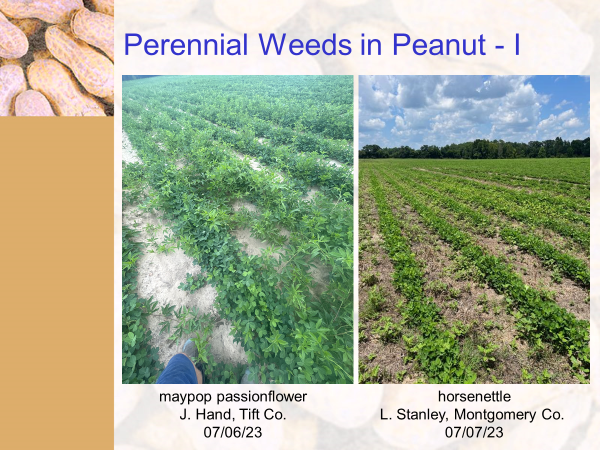
2) Last week, I received numerous inquiries about controlling broadleaf perennial weeds in peanut (dogfennel, horsenettle, maypop passionflower, heliotrope, etc.). None of the herbicides we have in our peanut arsenal work well on these types of weeds. Growers who have perennial weeds in their peanut fields might consider the following:
a) If perennial weeds are in small spots and growers are willing to sacrifice the peanuts in those spots, they can be spot treated with a high rate of glyphosate (i.e. Roundup PowerMax3 5.88SL @ 44 oz/A or equivalent).
b) In the fall after harvest, allow perennial weeds to regrow then treat fields with a high rate of glyphosate (same rate as above). This fall application of glyphosate must be be applied at least 2 weeks before first frost. Then in the spring of next year, plant RR-field corn or Xtend soybeans/cotton and plan on using a POST combination of glyphosate + dicamba in those crops.
c) It will take multiple years of fall + spring applications of glyphosate to get perennial weeds under control. It took more than 1 year for these weeds to become a problem and will take more than 1 year to get them under control.
d) Avoid planting peanuts in fields with known populations of perennial weeds.

3) Pink purslane has been a bur under my saddle for many years. Consequently, my PhD graduate student (Nick Shay) is conducting POST control studies as part of his dissertation. Nick already completed 2 trials in the greenhouse last fall and 1 field trial this summer. The following are the recent results of the field trial that he conducted. Surprisingly, only Aatrex (atrazine) and Cobra (lactofen) were effective in this POST trial. This field trial will be repeated again later this summer.


Subscribe to:
Posts (Atom)